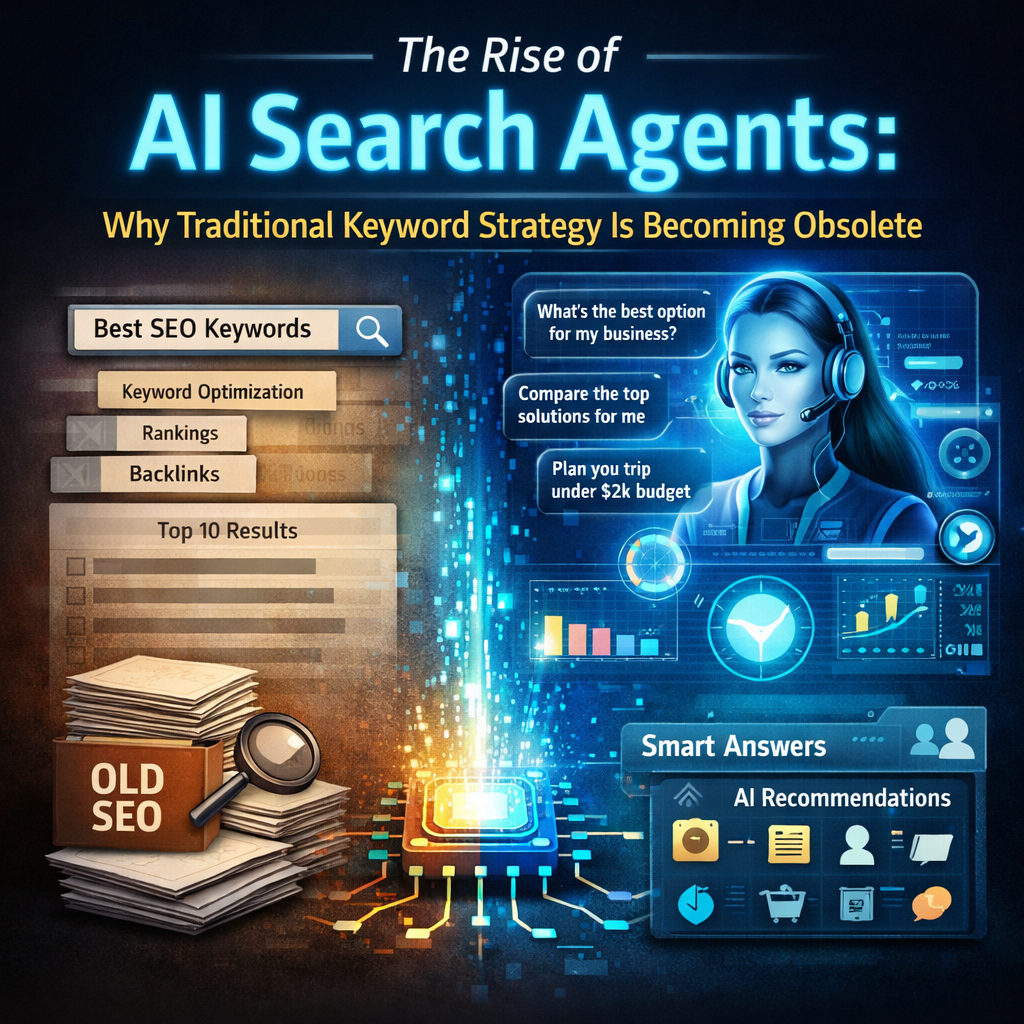
This shift hasn’t happened by accident.
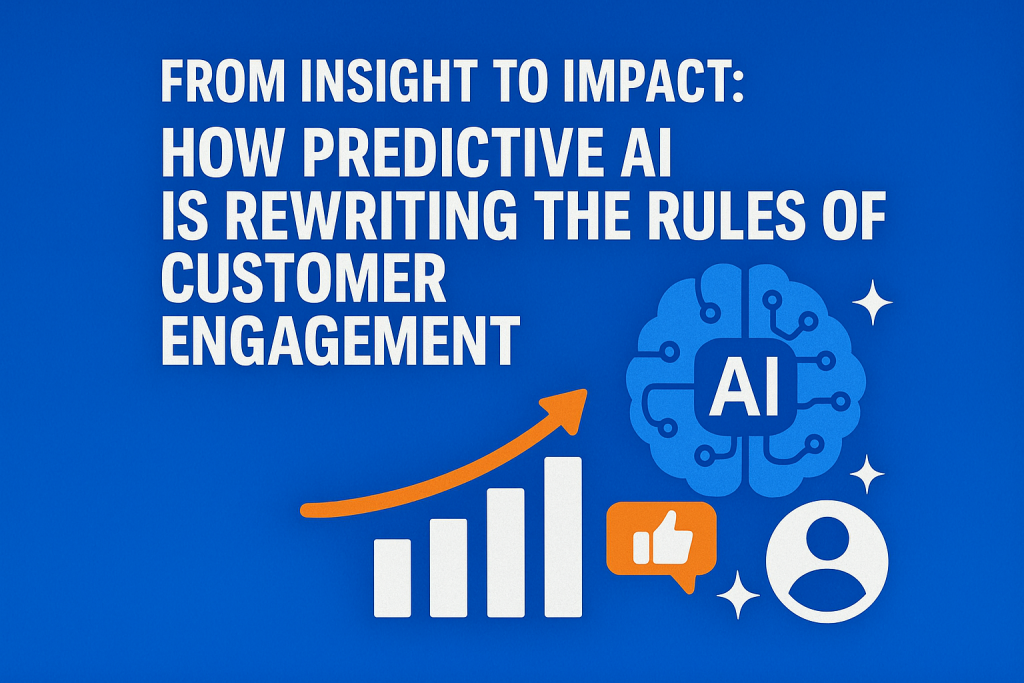
Predictive AI is fundamentally rewriting the rules of customer engagement. It’s transforming how brands understand behavior, build experiences, and create impact. The companies winning today—and the ones poised to dominate tomorrow—are those who harness Predictive AI not just to understand what customers did, but to shape what they’ll do next.
This is not about automation.
Not about convenience.
Not even about efficiency.
It’s about intelligence-driven connection.
Welcome to the era where data becomes foresight, foresight becomes action, and action becomes sustained growth.
Below, we break down how Predictive AI is changing the landscape—and how your business can leverage it for deeper engagement, faster decisions, and transformational results.
What Exactly Is Predictive AI?
Predictive AI combines advanced machine learning, behavioral analytics, historical data, and real-time signals to forecast customer actions and preferences.
Traditional analytics tells you:
What happened
When it happened
Who it happened to
Predictive AI tells you:
What will likely happen next
Why a customer will act
When a moment of intent will occur
How to influence behavior before your competitor does
In essence, Predictive AI shifts marketing from reactive to proactive.
It allows brands to engage customers with:
This creates a seamless customer journey—one where the brand feels intuitive, intelligent, and fully aligned with the user’s wants.
Why Predictive AI Matters More Than Ever
Consumer behavior is no longer linear. Modern decision-making is fast, unpredictable, emotional, and heavily influenced by micro-moments.
70% of consumers expect personalization in their digital experiences.
80% of customers are more likely to buy from brands that act on real-time intent.
AI-driven personalization can increase revenue by 15–20% on average.
Predictive AI is at the center of this transformation.
As audience attention spans shrink and competition grows, businesses must engage customers before they drift away. Predictive AI gives you the power to stay ahead by identifying the moments where engagement matters—and acting on them instantly.
The Core Forces Driving Predictive AI Forward
1. Behavioral Data + Machine Learning
AI can process millions of data points—far beyond human capability.
These include:
Browsing patterns
Purchase history
Engagement behavior
Device and timing patterns
Sentiment analysis
Abandonment signals
Micro-interactions (clicks, hovers, dwell time)
Alone, these data points mean little. But with machine learning, patterns begin to emerge.
AI learns:
Who is likely to buy
Who is about to churn
Who needs support
Who is ready for an upgrade
Who is researching competitors
Who is primed for retention
This intelligence gives marketers and brands unprecedented clarity.
2. Real-Time Personalization
Predictive AI doesn’t wait for weekly or monthly reports—it adjusts on the fly.
Imagine:
A website homepage that transforms based on visitor intent
Product pages that rearrange depending on what someone is likely to buy
Emails triggered at the exact moment a customer is most receptive
Push notifications that respond to behavior in real-time
Chatbots that anticipate needs rather than respond to questions
This level of dynamic personalization is the new competitive advantage.
3. Predictive Content & Messaging
AI helps brands craft messaging that resonates by analyzing:
This leads to:
The result is marketing that doesn’t feel like marketing—it feels like a conversation.
4. Predictive UX (User Experience)
Predictive AI not only forecasts behavior—it optimizes experience design.
It can determine:
Which layouts convert best
Which CTAs drive the highest response
Which navigation items create friction
How to streamline checkout flow
Where users are likely to drop off
The result?
Websites, apps, and funnels that adapt themselves to customer behavior, not the other way around.
How Predictive AI Is Rewriting the Rules of Customer Engagement
Below are the biggest shifts Predictive AI is creating in the world of marketing, CX, and business performance.
Rule #1: Engagement Now Starts Before the Customer Takes Action
Traditionally, brands responded after a customer engaged:
A click
A search
A form submission
A purchase
But Predictive AI allows brands to initiate engagement before the customer acts.
Examples:
Sending a retention offer before a churn event
Delivering product recommendations before a search query
Triggering support before frustration escalates
Detecting declining engagement days or weeks early
Sending reminders before a customer forgets
Brands are no longer following the customer—they’re leading them.
Rule #2: One Customer ≠ One Persona
The era of fixed personas is over.
Predictive AI identifies evolving micro-segments based on real behavior. One customer may show multiple personas depending on:
Predictive AI adapts instantly by detecting the context behind the behavior.
This shifts engagement from static to dynamic.
Rule #3: Messaging Timing Is Now More Important Than Messaging Content
You can have the perfect message—but if it’s delivered at the wrong moment, it won’t land.
Predictive AI identifies:
When a customer is most likely to open email
When they’re most likely to purchase
When they’re inactive or distracted
When a re-engagement campaign is necessary
When intent signals spike
Timing becomes a strategic weapon.
Rule #4: Every Customer Touchpoint Is Now a Data Source
Customer interactions used to be siloed:
Ad engagement
Email clicks
Website sessions
Sales conversations
Customer support chats
Predictive AI connects all of these into a unified engagement model.
Every micro-signal becomes actionable. Every behavior becomes insight. Every touchpoint becomes fuel for a better experience.
Rule #5: CX (Customer Experience) Is Now Continuous, Not Campaign-Based
Campaigns are static. Customer behavior is not.
Predictive AI enables continuous engagement by:
Updating audience segments in real-time
Adjusting scoring models dynamically
Shifting content and offers daily, even hourly
Triggering automated responses based on intent
CX is no longer dependent on the marketer to push it—it becomes an ongoing, intelligent ecosystem.
Rule #6: AI Doesn’t Replace Marketers—It Amplifies Them
The best brands don’t use Predictive AI to replace strategy. They use it to:
Clear the noise
Eliminate guesswork
Accelerate decision-making
Unlock creative potential
Expand personalization beyond human capability
Marketers who understand Predictive AI become more valuable—not less.
AI does the heavy lifting. Humans do the visionary work.
How Businesses Can Use Predictive AI Today
You don’t need massive infrastructure or big tech budgets to adopt Predictive AI. Modern tools make predictive capabilities accessible to businesses of all sizes.
Here are the most powerful use cases.
1. Predictive Lead Scoring
AI predicts:
This increases close rates and improves pipeline efficiency instantly.
2. Predictive Content Delivery
AI identifies:
The right format
The right topic
The right message
The right moment
and delivers content automatically based on engagement probability.
3. Predictive Product Recommendations
From ecommerce to SaaS, Predictive AI anticipates what each customer will want next—reducing friction and increasing revenue.
4. Predictive Churn Prevention
AI detects:
Brands can step in before churn happens.
5. Predictive Ad Optimization
Predictive AI helps you:
Target the right audiences
Reduce wasted ad spend
Identify high-intent users
Forecast campaign performance
Predict which creative elements convert
Your budget becomes smarter. Your targeting becomes tighter.
6. Predictive Sales Outreach
AI helps sales teams determine:
Which leads are in buying mode
What messaging will resonate
When outreach should be sent
Which offers drive conversion
It’s like giving your sales team a radar system.
7. Predictive Personalization Across All Channels
Email, SMS, ads, website, chatbots, push notifications—they all become individualized.
One customer can receive a completely different experience from another.
That is the real power of Predictive AI.
The Ethical Layer: Transparency, Consent, and Trust
With great predictive power comes great responsibility.
Businesses must adopt:
Transparent data practices
Clear privacy policies
Consent-based data collection
AI explainability standards
Customers will accept (and even appreciate) predictive personalization as long as it feels helpful, not intrusive.
The brands who balance relevance with respect will win big.
The Future of Customer Engagement in the Age of Predictive AI
Predictive AI is only getting started. Over the next five years, expect to see:
1. Hyper-Personalized Customer Journeys
Where no two user paths are ever the same.
2. Emotion-Aware AI
Engagement tailored to mood, sentiment, and emotional signals.
3. Proactive Support Systems
AI that solves problems before they escalate.
4. Predictive Creativity
AI that helps ideate and generate personalized creative assets at scale.
5. Autonomous AI Agents
Systems that take action across channels without human intervention.
The future of customer engagement is:
Predictive
Proactive
Personal
Adaptive
AI-powered
Brands that embrace this shift will be the ones shaping the next generation of customer experiences.
Final Thoughts: Insight Is No Longer Enough—Impact Is the New Standard
We’ve entered a new era where customer engagement is no longer reactive, transactional, or generic. Predictive AI has elevated the game.
Insight alone doesn’t move the needle anymore.
Impact does.
Predictive AI allows brands to convert insights into meaningful action at scale—faster, smarter, and more precisely than ever before.
Whether you’re a startup, an evolving brand, or an enterprise-level business, the opportunity is the same:
Leverage Predictive AI to understand your customers more deeply, engage them more intelligently, and build experiences that feel effortless, human, and unforgettable.
The rules of customer engagement have been rewritten. The only question is—
Are you ready to lead in this new era?