



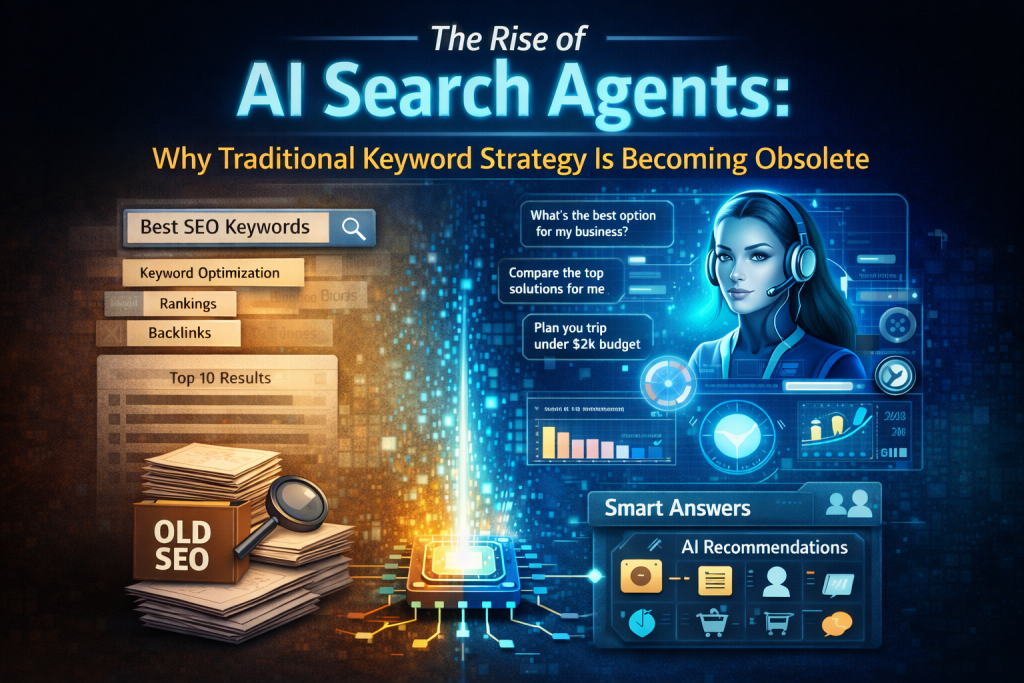

We are entering a new phase of discovery powered by AI search agents: intelligent systems that don’t just retrieve links, but understand intent, synthesize answers, and guide decisions. These agents are reshaping how people find information, evaluate brands, and ultimately choose who to trust.
This shift doesn’t mean SEO is dead.
It means keyword-first SEO is no longer enough.
In this article, we’ll break down:
What AI search agents actually are
Why keyword-centric strategies are losing effectiveness
How discovery is shifting from search results to answers
What brands must do now to stay visible in an AI-first world
If your digital strategy still depends on ranking for a list of keywords, this is your wake-up call.
AI search agents are intelligent, conversational systems designed to perform search on behalf of users, not just return a list of results.
Unlike traditional search engines that match queries to indexed pages, AI search agents:
Interpret context and intent
Pull from multiple sources simultaneously
Summarize, compare, and recommend
Learn from follow-up questions
Reduce friction between question and action
Think less “search engine” and more research assistant, advisor, and concierge combined.
Examples already shaping behavior include:
Conversational AI tools like OpenAI’s ChatGPT
AI-powered search experiences inside Google
Agent-based tools that plan trips, compare vendors, or shortlist products automatically
Users aren’t just searching anymore—they’re delegating discovery.
Traditional SEO was optimized for:
Short, transactional queries
Static pages competing for rankings
A user willing to click through multiple links
That model worked when:
Search results were lists of blue links
Content lived in silos
Users did the comparison work themselves
But today’s users want:
Immediate answers
Contextual recommendations
Fewer steps
Less cognitive load
AI search agents deliver exactly that.
When an AI agent can answer:
“What’s the best marketing strategy for a local service business with a $3k monthly budget?”
…there is no longer a need to click through 10 keyword-optimized blog posts.
The question didn’t disappear.
The click did.
Search behavior has fundamentally changed.
“Best CRM software”
“Digital marketing agency pricing”
“SEO services near me”
“What CRM works best for a small team with remote sales?”
“How should I allocate my marketing budget in 2026?”
“Which agency specializes in human-centric AI marketing?”
AI search agents thrive on natural language and layered intent, not exact-match keywords.
This is why:
Keyword stuffing feels irrelevant
Thin content gets ignored
Generic listicles are losing visibility
AI agents reward clarity, depth, and usefulness, not keyword density.
In an AI-driven discovery environment, ranking #1 doesn’t guarantee visibility.
AI search agents:
Pull snippets, concepts, and entities from multiple sources
Cite brands that demonstrate authority and clarity
Favor content that directly answers real questions
In many cases, the AI doesn’t even show the link—just the answer.
That means:
Traffic is no longer the only KPI
Mentions, citations, and semantic relevance matter more
Being “understood” is more important than being “ranked”
This is the shift from Search Engine Optimization (SEO) to Search Experience Optimization (SXO) and Answer Optimization.
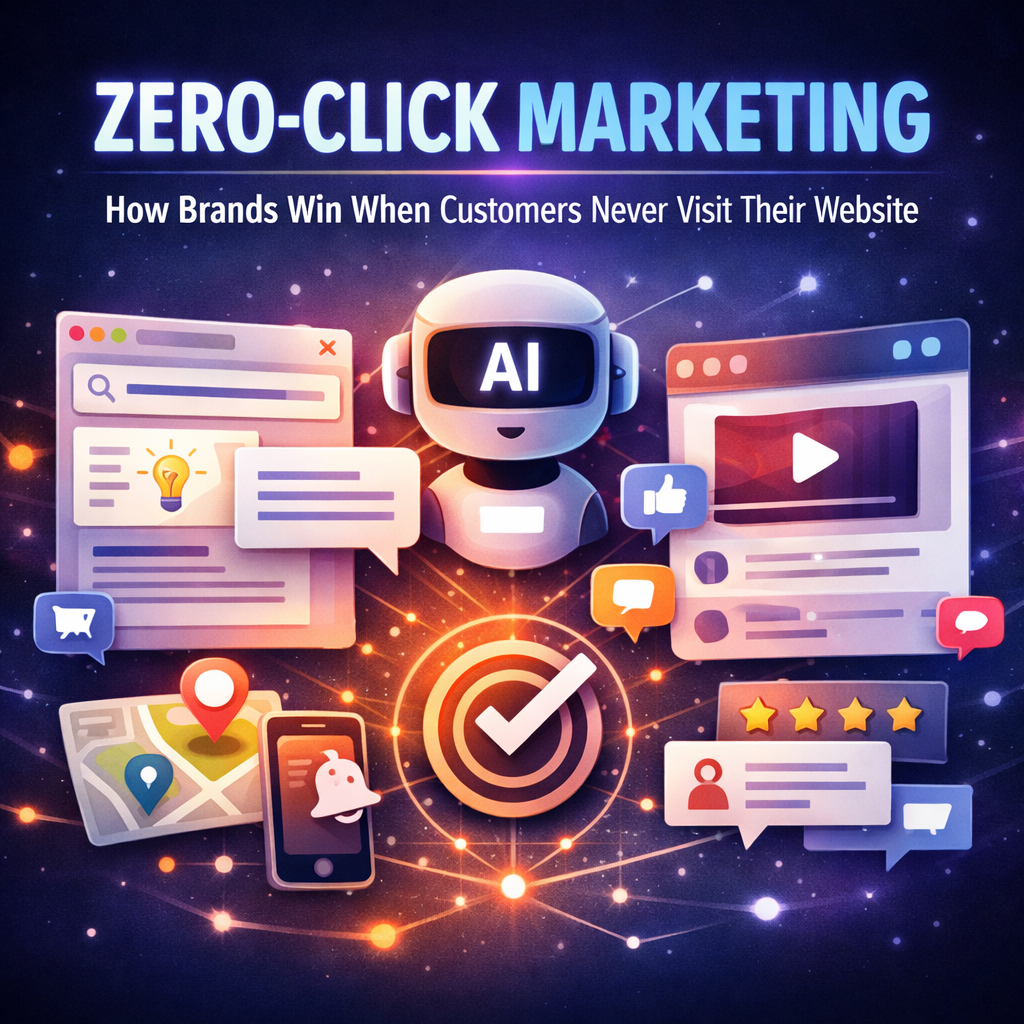
AI search agents accelerate an already growing trend: zero-click search.
Users increasingly:
Get answers without visiting websites
Make decisions inside AI interfaces
Trust summaries over source exploration
For brands, this creates a hard truth:
If your content can’t be summarized accurately by AI, it won’t be surfaced at all.
AI agents don’t reward:
Clickbait headlines
Vague positioning
Over-optimized fluff
They reward:
Clear explanations
Defined points of view
Consistent expertise across topics
In the keyword era, optimization could sometimes compensate for weak authority.
In the AI era, authority is the optimization.
AI search agents look for:
Subject-matter depth
Consistency across content
Clear brand positioning
Demonstrated experience (not just opinions)
This aligns closely with E-E-A-T principles:
Experience
Expertise
Authoritativeness
Trustworthiness
Brands that publish:
Thought leadership
Real insights
Case-driven content
Opinionated frameworks
…are far more likely to be referenced by AI agents than brands chasing keyword variations.
For years, marketers were told:
“Publish more content to rank more keywords.”
AI search agents flip that logic.
They prioritize:
Signal over volume
Relevance over frequency
Depth over breadth
A single, well-structured, authoritative article can outperform dozens of shallow posts because AI can:
Extract meaning
Identify expertise
Reuse insights across contexts
If your content strategy still revolves around “blog calendars filled with keyword targets,” you’re optimizing for a system that’s already fading.

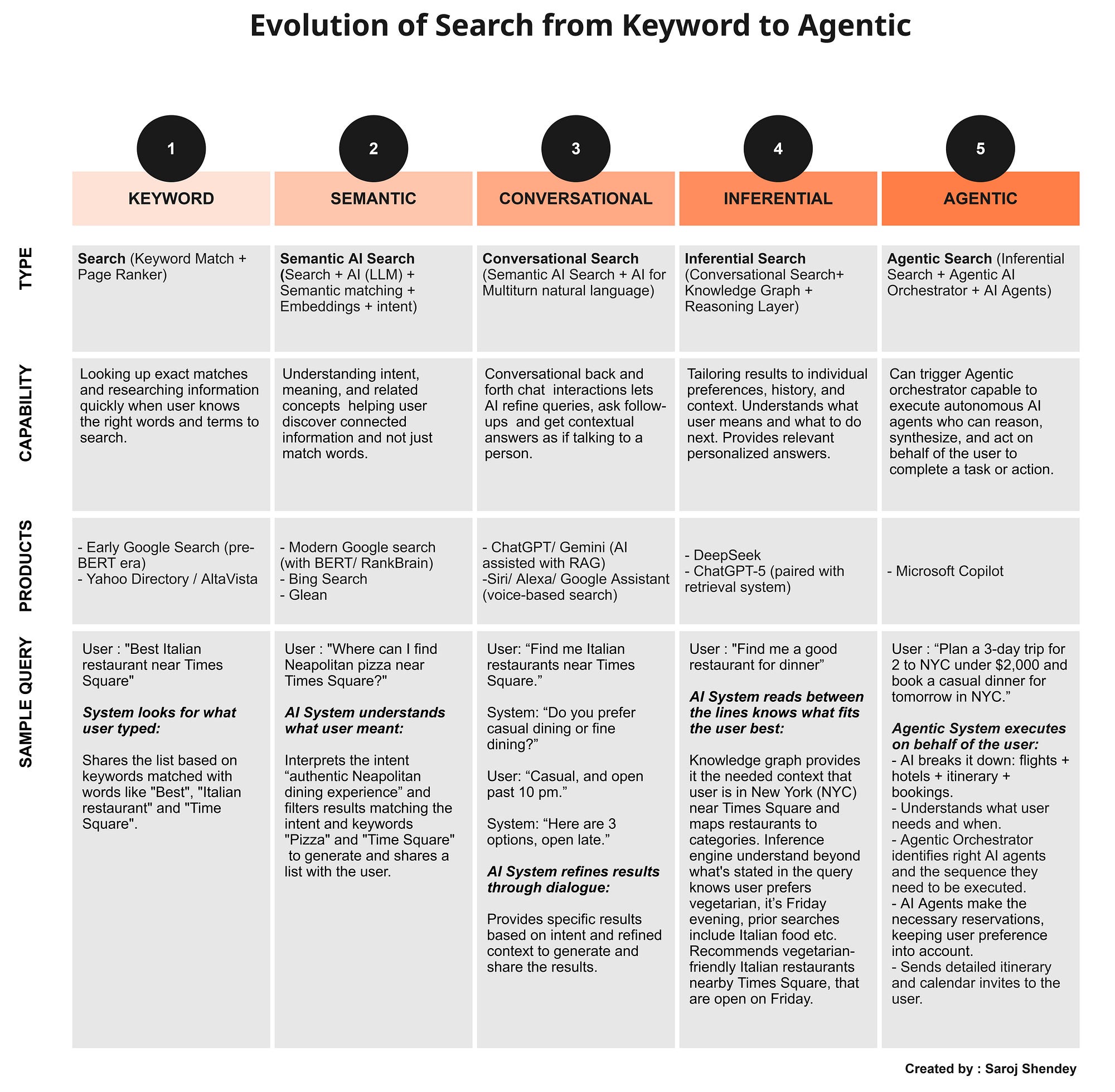
Traditional SEO supported linear funnels:
Awareness keyword
Consideration keyword
Conversion keyword
AI search agents collapse that funnel.
A single conversation can:
Identify a need
Compare options
Recommend a solution
Suggest next steps
This means:
Content must support decision-making, not just awareness
Pages must answer why, how, and what next
Brands must show up with contextual relevance, not just category relevance
Keyword research isn’t disappearing—but its role is changing.
Primary driver of content strategy
Central metric for success
Insight into language and intent
Supporting input, not the foundation
What replaces it?
Understand:
What problems your audience is trying to solve
What decisions they’re trying to make
What risks they’re trying to avoid
Build deep, interconnected content ecosystems around:
Core problems
Industry shifts
Use cases
Frameworks
Write content that:
Answers questions directly
Anticipates follow-ups
Uses natural language
Explains concepts simply but thoroughly
AI agents surface brands with clear opinions, not fence-sitters.
If your content sounds like everyone else’s, the AI has no reason to remember you.
AI search agents evaluate trust signals differently than classic algorithms.
They look for:
Consistency across channels
Depth on specific topics
Alignment between brand message and content
Clarity in who you serve and how you help
This means:
Generic positioning weakens discoverability
Human-centric language improves AI comprehension
Clear niche focus beats broad messaging
Ironically, being more human makes you more machine-readable.
Most brands are still:
Obsessing over keyword tools
Chasing incremental ranking gains
Measuring success only by traffic
Early adopters are:
Designing content for AI summarization
Structuring insights clearly
Building recognizable authority footprints
In 12–24 months, the gap between these two groups will be massive.
The brands AI agents trust first will become:
Default recommendations
Frequently cited sources
Category leaders by association
If you’re a founder, marketer, or agency leader, here’s the reality:
Keyword rankings alone won’t protect visibility
Traffic may decrease while influence increases
Being referenced will matter more than being visited
Your priorities should shift toward:
Publishing fewer, stronger pieces
Answering real questions deeply
Building recognizable expertise
Aligning content with how AI thinks—not how crawlers scan
The rise of AI search agents doesn’t kill SEO.
It kills lazy SEO.
The future belongs to brands that:
Educate instead of manipulate
Clarify instead of optimize
Lead conversations instead of chasing clicks
In an AI-driven world, the winners won’t be the loudest or the most optimized.
They’ll be the most helpful.
And that’s a future worth optimizing for.