
Today, users aren’t clicking through funnels.
They’re having conversations.
They’re asking ChatGPT, Perplexity, Gemini, Claude, and AI-powered search experiences direct questions—and expecting direct, personalized answers. They’re engaging with AI chat interfaces embedded into websites, CRMs, social platforms, and even ads.
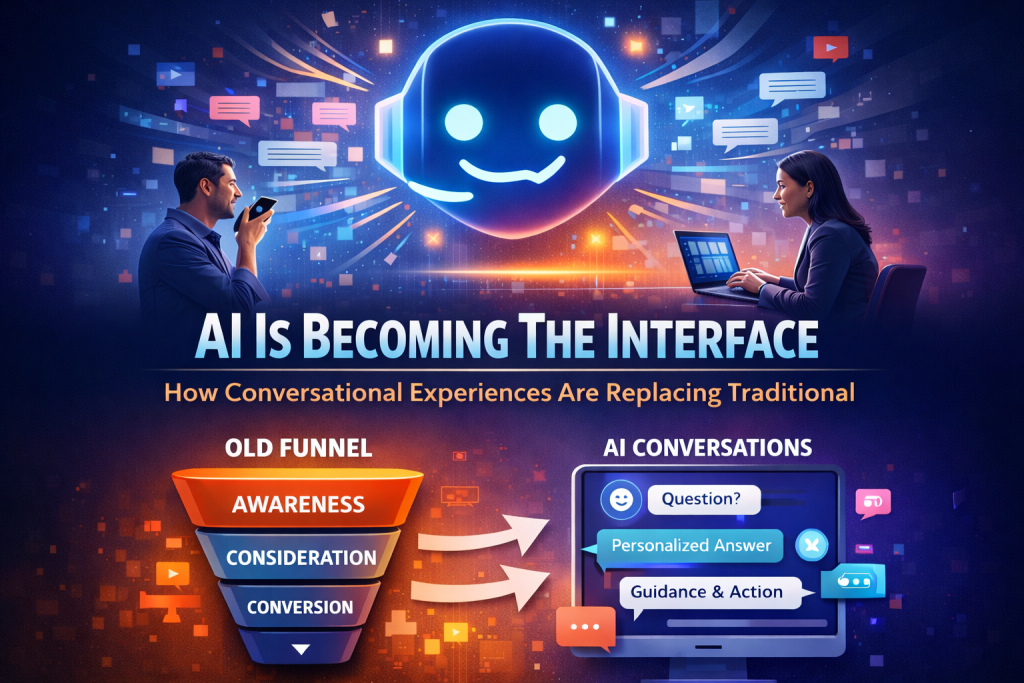
In short: AI is becoming the interface.
And conversational experiences are quietly replacing traditional funnels.
This shift isn’t theoretical. It’s already happening—and brands that don’t adapt will feel it in lost visibility, lost trust, and lost revenue.
Let’s break down what this means, why it matters, and how businesses must evolve.
The Death of the Click-Heavy Funnel (As We Know It)
Traditional funnels were built for a different internet.
An internet where:
-
Users browsed multiple pages
-
Content discovery happened primarily through Google links
-
Conversion required several intentional steps
-
Attention spans were longer
-
Information asymmetry favored brands
That internet is gone.
What’s Changed?
-
Search Is Becoming Conversational
Users now ask full questions, not keywords:-
“What’s the best CRM for small businesses?”
-
“How do I scale my marketing without hiring more people?”
-
“Which agency actually understands human-centric branding?”
AI responds with synthesized answers—often without sending traffic anywhere.
-
-
Zero-Click Experiences Are the Norm
AI Overviews, featured snippets, social search, and chat interfaces deliver answers instantly.
Clicking is optional. Often unnecessary. -
Users Expect Personalization Immediately
People don’t want to dig.
They want relevance, context, and clarity—now. -
Trust Is Built Through Dialogue, Not Pages
Static pages feel cold.
Conversations feel human.
Funnels assumed patience.
AI-powered users don’t have it.
AI as the New Front Door
In the past, your homepage was your front door.
Today, AI is your front door.
Whether it’s:
-
A conversational AI answering questions on your site
-
A chatbot inside Instagram DMs
-
An AI assistant summarizing your expertise
-
A search engine responding on your behalf
Your brand is being represented before a user ever visits your website.
That’s a fundamental shift.
From Destination to Interaction
Instead of asking:
“How do we get users to our site?”
Brands must now ask:
“How does our brand show up inside conversations?”
This includes:
-
AI search summaries
-
Conversational commerce tools
-
AI-driven customer support
-
Voice search and smart assistants
-
In-app AI experiences
Your content, positioning, tone, and authority now live inside interfaces you don’t fully control.
Why Conversational Experiences Win
Conversational experiences outperform funnels for one simple reason:
They align with human behavior.
Humans don’t think in funnels.
They think in questions.
Conversations Feel Natural
A conversation:
-
Responds in real time
-
Adapts to context
-
Feels personalized
-
Builds trust incrementally
-
Reduces friction
A funnel:
-
Assumes linear thinking
-
Forces predefined paths
-
Requires multiple commitments
-
Loses people at every step
AI-powered conversations collapse the distance between curiosity and clarity.
The Shift From Funnels to Flows
Funnels are rigid.
Conversations are fluid.
Modern marketing is moving from funnels to flows.
What Is a Conversational Flow?
A conversational flow:
-
Starts with intent, not stage
-
Adapts based on user input
-
Provides value before conversion
-
Guides instead of pushes
-
Feels like help, not sales
Instead of:
Awareness → Consideration → Conversion
It looks more like:
Question → Context → Guidance → Confidence → Action
AI makes this possible at scale.
AI Chatbots Are Not the Same as Conversational Experiences
Important distinction:
Not all chatbots are conversational experiences.
Most chatbots fail because they:
-
Are scripted
-
Can’t handle nuance
-
Feel robotic
-
Exist only to deflect support tickets
True conversational experiences:
-
Use AI + brand intelligence
-
Understand intent, not just keywords
-
Reflect brand voice and values
-
Integrate with data and systems
-
Learn and improve over time
This is where agentic AI enters the picture.
Agentic AI: The Engine Behind Conversational Marketing
Agentic AI doesn’t just respond—it acts.
It can:
-
Ask follow-up questions
-
Guide users toward outcomes
-
Personalize recommendations
-
Trigger workflows
-
Learn from interactions
Instead of a funnel with steps, you get an intelligent guide.
Examples:
-
A visitor asks, “Is this right for my business?”
-
The AI asks clarifying questions
-
It tailors responses based on industry, size, goals
-
It recommends next steps
-
It books a call or delivers content dynamically
No form.
No forced path.
No friction.
Conversational Experiences Across the Customer Journey
This shift impacts every stage—not by replacing strategy, but by changing execution.
Discovery
AI-powered search and social discovery surface brands through:
-
Thoughtful answers
-
Credible insights
-
Clear positioning
SEO is no longer just ranking pages—it’s training AI systems to understand your expertise.
Consideration
Instead of comparison pages, users ask:
-
“Which option fits my situation?”
-
“What should I avoid?”
-
“What actually works?”
Conversational AI can:
-
Address objections
-
Provide context
-
Educate in real time
-
Build trust faster
Conversion
Conversations reduce decision anxiety.
They:
-
Answer last-mile questions
-
Clarify pricing or fit
-
Remove uncertainty
-
Guide action naturally
Retention & Growth
Post-purchase, conversational AI:
-
Improves onboarding
-
Reduces support friction
-
Suggests next best actions
-
Deepens relationships
Funnels end at conversion.
Conversations continue.
What This Means for Websites
Websites aren’t obsolete—but their role is changing.
They are no longer just:
-
Information containers
-
Landing page factories
-
Conversion traps
They are becoming:
-
Knowledge hubs
-
AI training grounds
-
Trust anchors
-
Conversation starters
Your site must now:
-
Be structured for AI understanding
-
Reflect clear expertise and authority
-
Support conversational layers
-
Integrate with chat and AI interfaces
Static pages alone won’t cut it.
SEO in a Conversational World
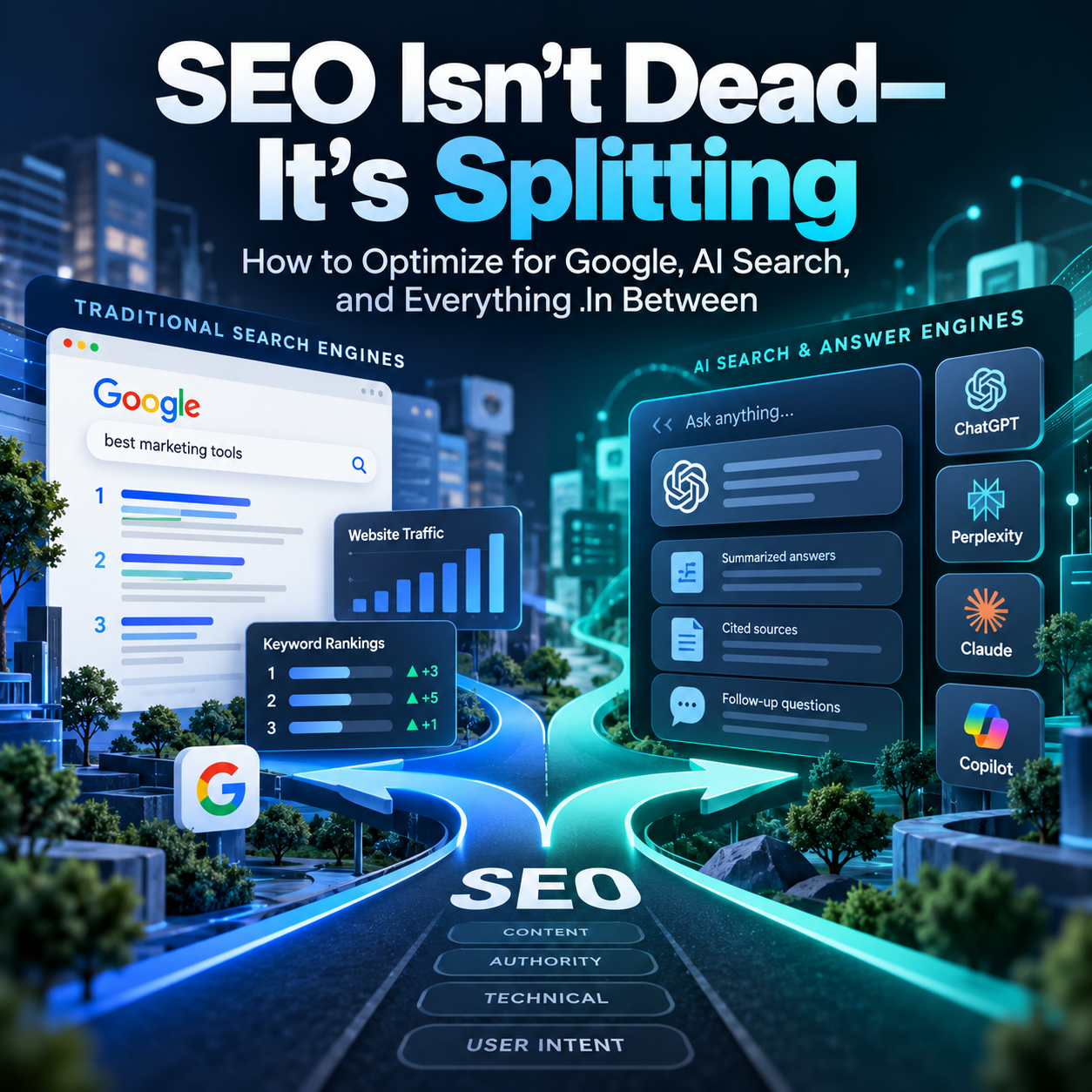
SEO isn’t dead—it’s evolving.
Ranking is no longer the only goal.
Representation is.
You must optimize for:
-
Entity clarity
-
Topical authority
-
Conversational relevance
-
Answer depth
-
Trust signals
If AI doesn’t understand your brand, it can’t recommend you.
This is why:
-
Human-centric content matters
-
Clear positioning matters
-
Real expertise beats generic fluff
-
Authentic voice outperforms keyword stuffing
Trust Is the New Currency
In conversational environments, users rely on AI to filter truth from noise.
That means:
-
Brands with shallow content disappear
-
Brands without clarity get ignored
-
Brands without trust lose relevance
AI doesn’t reward hype.
It rewards substance.
If your brand:
-
Solves real problems
-
Communicates clearly
-
Demonstrates experience
-
Shows empathy
AI becomes your amplifier.
If not, it becomes your filter.
How Brands Must Adapt Now
To stay competitive, brands must shift mindset and execution.
1. Design for Conversations, Not Clicks
Ask:
-
What questions do our customers actually ask?
-
Where do they ask them?
-
How can we answer clearly and honestly?
2. Build AI-Readable Authority
Structure content so AI can understand:
-
Who you help
-
What you do
-
Why you’re credible
-
How you’re different
3. Integrate Conversational Interfaces
This includes:
-
Website chat
-
Social DMs
-
AI search optimization
-
CRM-integrated assistants
4. Prioritize Human-Centric Messaging
AI scales content.
Humans connect with meaning.
Your voice still matters—more than ever.
The Future: Marketing as Dialogue
We are moving toward a world where:
-
Marketing feels like guidance
-
Sales feels like support
-
Brands feel like partners
-
AI feels invisible
Funnels didn’t disappear overnight.
But conversations are already outperforming them.
The brands that win won’t be the loudest.
They’ll be the clearest.
They won’t chase attention.
They’ll earn trust.
They won’t force paths.
They’ll guide journeys.
Final Thought
AI isn’t replacing marketers.
It’s replacing friction.
And the interface of the future isn’t a page—it’s a conversation.
The question isn’t whether conversational experiences will replace traditional funnels.
The question is:
Will your brand be part of the conversation—or filtered out of it?