For years, digital marketing revolved around a single goal: drive traffic to your website. Clicks were the currency. Pageviews were the scoreboard. Conversions were expected to happen only after a user landed on your domain.
But the internet has changed.
Today, many of your best prospects will never click your link — and that’s not a failure. It’s the new reality.
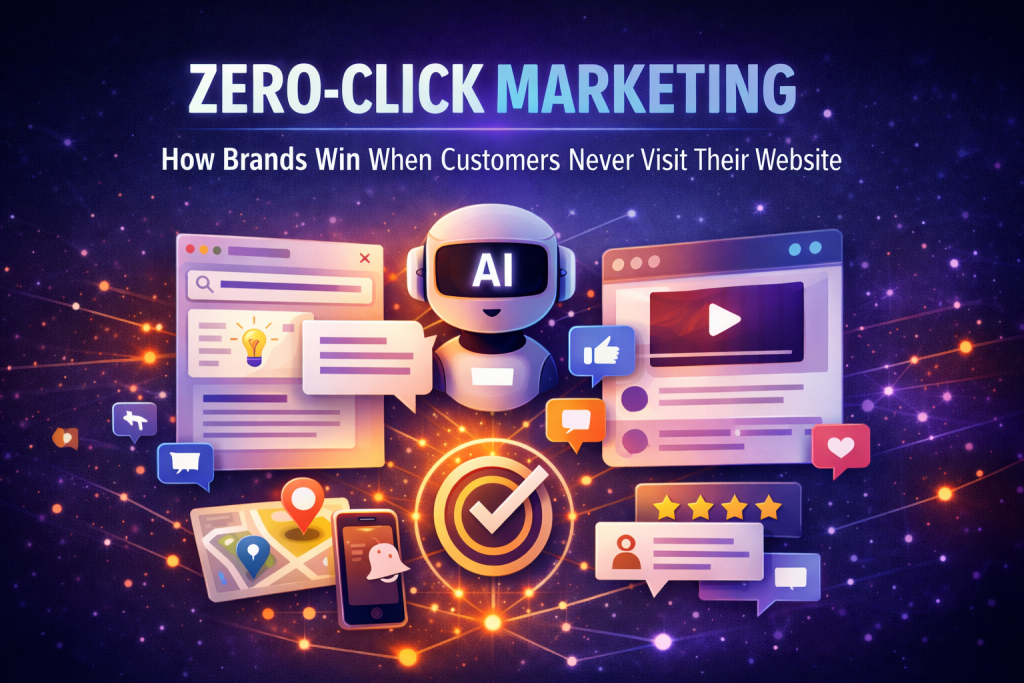
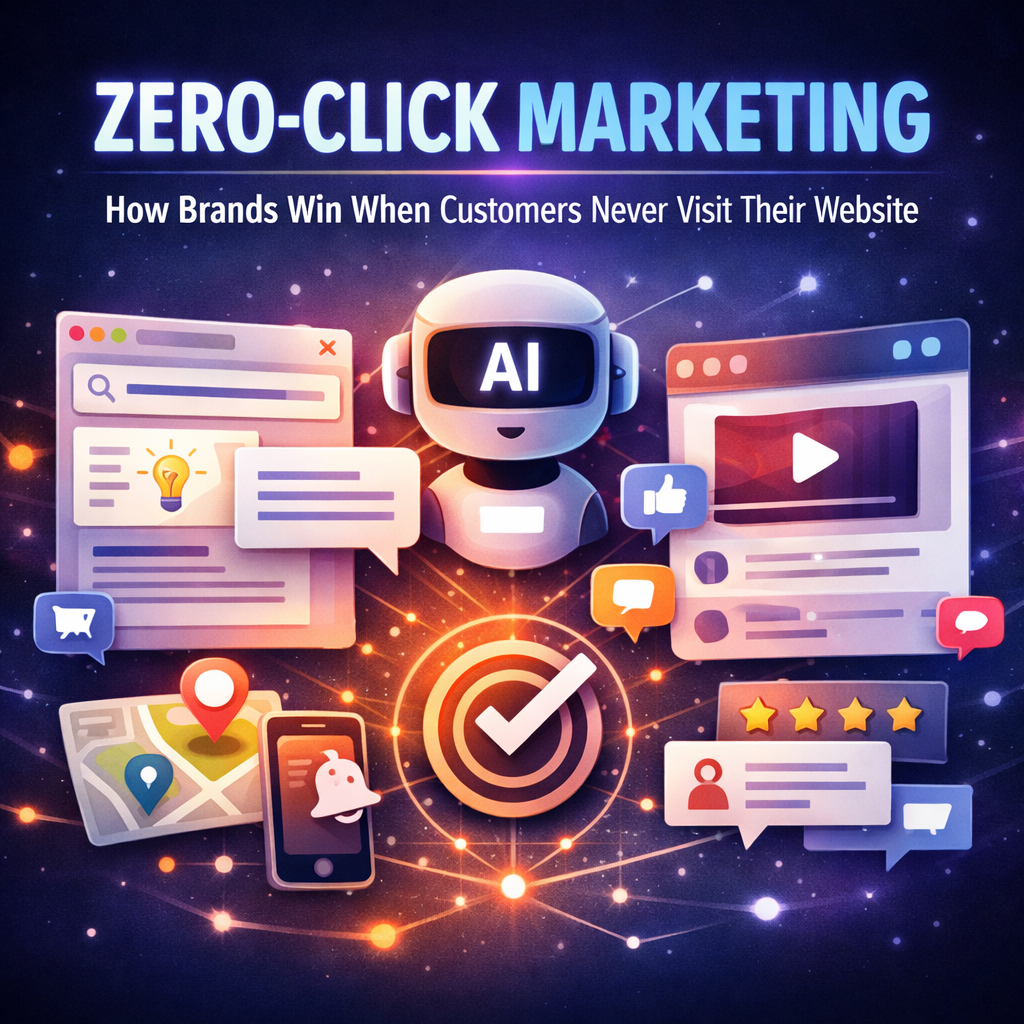
Welcome to zero-click marketing, where brands win visibility, trust, and revenue without requiring customers to visit their website at all.
Search engines answer questions directly. Social platforms keep users inside their ecosystems. AI assistants summarize content before anyone scrolls. Marketplaces, maps, feeds, and inboxes now are the customer journey.
This shift doesn’t mean your website is obsolete. It means your website is no longer the center of gravity.
In this article, we’ll break down what zero-click marketing really means, why it’s accelerating, how it impacts SEO and content strategy, and — most importantly — how brands can thrive in a world where attention is captured everywhere except their homepage.
What Is Zero-Click Marketing?
Zero-click marketing is the practice of delivering value, visibility, and influence without requiring a website visit.
A zero-click interaction occurs when a user:
Gets the answer they need directly from a search result
Consumes your content natively on social media
Engages with your brand through AI-generated summaries
Makes a decision based on reviews, profiles, or snippets without clicking through
The defining characteristic isn’t the absence of conversion — it’s the absence of a traditional click.
And that’s important: zero-click does not mean zero impact.
In fact, some of the most influential moments in the customer journey now happen before a click ever occurs — or without one entirely.
Why Zero-Click Experiences Are Exploding
Zero-click behavior didn’t appear overnight. It’s the result of several major shifts happening at the same time.
1. Search Engines Are Becoming Answer Engines
Search platforms are no longer just directories. They’re destinations.
Featured snippets, People Also Ask sections, local packs, AI overviews, and knowledge panels are designed to keep users on the results page by delivering immediate answers.
From the platform’s perspective, this is good UX.
From the user’s perspective, it’s efficient.
From the brand’s perspective, it’s a wake-up call.
Your content might be performing exceptionally well — without driving traffic.
2. Social Platforms Reward Native Content
Social networks don’t want users leaving.
That’s why text posts, carousels, native videos, stories, and in-feed education outperform outbound links. The algorithm rewards content that keeps people scrolling — not clicking away.
Brands that rely solely on “link in bio” strategies are competing uphill against platforms designed to reduce clicks.
3. AI Is Becoming the First Touchpoint
AI tools now summarize blog posts, compare vendors, and answer complex questions — often without showing users the original source.
This doesn’t eliminate content creators. It shifts the battleground.
Brands that structure content clearly, authoritatively, and consistently are the ones AI systems reference — even if users never visit the site.
4. Trust Is Built Before Traffic Happens
Modern buyers research quietly.
They read comments.
They watch short clips.
They scan reviews.
They follow thought leaders.
They observe consistency.
By the time they’re ready to convert, they already know who they trust — and many brands never see that invisible journey happening.
The Death of Clicks (As a Primary KPI)
Clicks used to be the signal.
Now, they’re a lagging indicator.
If your strategy is optimized only for:
Website sessions
Bounce rates
Pageviews
You’re measuring outcomes, not influence.
Zero-click marketing forces a new set of questions:
Are we visible where decisions are made?
Are we shaping perception even without traffic?
Are we recognized as a credible authority?
Winning brands track impressions, reach, saves, shares, engagement, branded searches, and recall — not just clicks.
SEO in a Zero-Click World
SEO isn’t dying. It’s evolving.
Traditional SEO asked:
“How do we rank and get the click?”
Zero-click SEO asks:
“How do we become the answer?”
The New Role of SEO Content
Your content now serves three audiences simultaneously:
Humans skimming for clarity
Algorithms extracting meaning
AI systems summarizing intent
This means:
Clear structure matters more than clever copy
Headings must answer questions directly
Definitions should be concise and authoritative
Context must be unambiguous
Even if a user never clicks, your brand can still own the answer.
Brand Visibility Without Traffic
If your content is:
Featured in snippets
Referenced in AI summaries
Cited in comparison responses
Displayed in local results
You’re influencing decisions — silently.
SEO becomes less about traffic volume and more about search presence dominance.
Social Media as a Zero-Click Funnel
Social platforms are no longer top-of-funnel. They are the funnel.
Content That Wins Without Links
The strongest zero-click social content:
Think:
If your audience can fully consume your value without leaving the platform, the platform rewards you — and the audience remembers you.
The Real CTA Isn’t “Click”
In zero-click marketing, the most powerful CTAs are:
“Follow for more”
“Save this”
“Share with your team”
“Remember this brand”
Those actions compound visibility and trust long before a conversion ever happens.
Zero-Click Doesn’t Eliminate Websites — It Repositions Them
Your website isn’t dead. It’s just no longer the starting line.
Instead, your website becomes:
By the time someone visits your site in a zero-click ecosystem, they’re often:
Traffic quality improves even as volume decreases.
How Brands Win With Zero-Click Marketing
Winning brands don’t fight zero-click behavior — they design for it.
1. Optimize for Visibility, Not Just Visits
Your brand should show up consistently across:
Search results
Social feeds
AI responses
Local listings
Review platforms
Omnipresence beats ownership of a single destination.
2. Build Recognizable Authority
Authority compounds.
When users repeatedly see your brand delivering clear, helpful insights — even without clicking — trust builds passively.
That trust pays dividends later.
3. Design Content for Extraction
Assume your content will be:
Quoted
Summarized
Repurposed
Referenced
Make it easy for machines and humans to extract value without distortion.
4. Measure Influence, Not Just Traffic
Track:
These are zero-click success signals.
The Brands That Lose in a Zero-Click Era
Brands that struggle with zero-click marketing tend to:
Gate everything behind links
Optimize only for traffic
Ignore native platform behavior
Treat content as bait instead of value
In a world where attention is earned instantly, withholding value is the fastest way to become invisible.
The Future: Marketing Without Destinations
The future of marketing isn’t about driving everyone to one place.
It’s about being everywhere that matters — with clarity, consistency, and credibility.
Zero-click marketing rewards brands that:
The brands that win won’t ask, “How do we get the click?”
They’ll ask, “How do we become unforgettable — even without one?”
And that’s where modern growth truly happens.