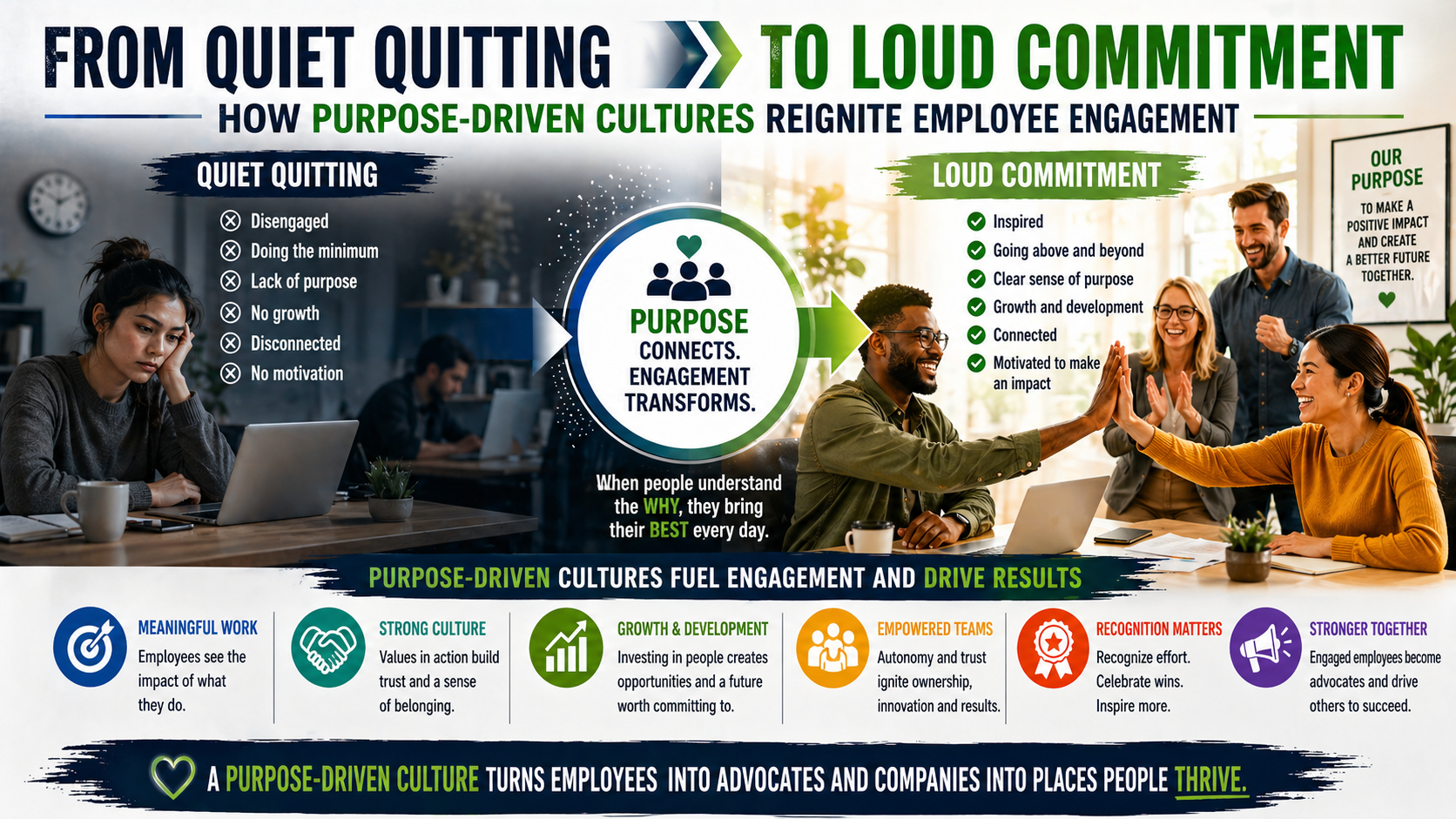
Over the past few years, the workplace has undergone a profound transformation. One of the most talked-about trends—quiet quitting—isn’t about employees literally leaving their jobs. Instead, it reflects a deeper disengagement: doing the bare minimum, emotionally checking out, and disconnecting from the company’s mission.
But here’s the opportunity: organizations that recognize this shift can turn it into a powerful advantage.
Enter loud commitment—a culture where employees are energized, aligned with purpose, and actively invested in outcomes. The bridge between these two extremes isn’t more perks, higher salaries, or stricter policies. It’s something far more impactful:
👉 A purpose-driven culture.
In this article, we’ll break down why quiet quitting happens, what loud commitment looks like, and how building a purpose-driven culture can reignite employee engagement at every level.
What Is Quiet Quitting, Really?
Quiet quitting is often misunderstood. It’s not laziness—it’s a signal.
Employees who quietly quit are:
- Disengaged but still present
- Meeting expectations, but not exceeding them
- Emotionally detached from their work
- Unmotivated to contribute beyond their role
The Root Causes
Quiet quitting is typically driven by:
1. Lack of Purpose
Employees don’t see how their work contributes to something meaningful.
2. Burnout and Overload
Constant pressure without recognition leads to emotional withdrawal.
3. Poor Leadership
Managers who fail to inspire, communicate, or support growth create disengagement.
4. Limited Growth Opportunities
When employees feel stuck, they stop investing effort.
5. Cultural Disconnect
A gap between company values and actual behavior erodes trust.
The Rise of Loud Commitment
If quiet quitting is disengagement, loud commitment is its opposite.
Loud commitment shows up as:
- Proactive problem-solving
- Genuine enthusiasm for work
- Strong collaboration and teamwork
- Advocacy for the company and its mission
- Willingness to go above and beyond
This isn’t forced. It’s earned.
And it comes from one key factor: alignment with purpose.
Why Purpose-Driven Cultures Matter More Than Ever
A purpose-driven culture connects daily work to a larger mission. It answers the question every employee is silently asking:
👉 “Why does my work matter?”
The Business Impact of Purpose
Organizations with strong purpose-driven cultures see:
- Higher employee engagement
- Lower turnover rates
- Increased productivity
- Stronger brand loyalty
- Better financial performance
Purpose isn’t just a feel-good concept—it’s a strategic advantage.
The Psychology Behind Engagement and Purpose
Human motivation isn’t just about compensation. It’s about meaning.
According to behavioral psychology, people are driven by:
- Autonomy (control over their work)
- Mastery (growth and development)
- Purpose (connection to something bigger)
When purpose is missing, engagement drops. When purpose is clear, performance accelerates.
Signs Your Culture Is Drifting Toward Quiet Quitting
Before you can fix the problem, you need to recognize it.
Warning Signs to Watch For
- Decreased participation in meetings
- Minimal collaboration across teams
- Lack of initiative or innovation
- Increased absenteeism or presenteeism
- Declining morale and energy
- Higher turnover or “silent attrition”
If these patterns exist, your culture likely needs a reset.
How Purpose-Driven Cultures Reignite Engagement
Transforming disengagement into commitment doesn’t happen overnight. It requires intentional cultural design.
Here’s how purpose-driven cultures make the difference:
1. They Create Meaningful Work
Employees want to feel like their work matters.
How to implement:
- Clearly connect roles to company impact
- Share customer success stories
- Highlight how individual contributions drive results
When employees see the impact of their work, they become emotionally invested.
2. They Align Values with Action
Many companies have values—but few live them.
Purpose-driven cultures:
- Reinforce values through behavior
- Recognize employees who embody them
- Hold leadership accountable
Consistency builds trust. Trust builds engagement.
3. They Empower Employees
Engagement thrives when employees feel ownership.
Ways to empower teams:
- Encourage decision-making at all levels
- Provide autonomy in how work gets done
- Support innovation and experimentation
Micromanagement kills engagement. Empowerment fuels it.
4. They Prioritize Growth and Development
Employees who grow stay engaged.
Strategies to implement:
- Offer continuous learning opportunities
- Create clear career pathways
- Invest in mentorship and coaching
When employees see a future, they commit to the present.
5. They Foster Strong Leadership
Leadership is the catalyst for culture.
Purpose-driven leaders:
- Communicate vision clearly and consistently
- Lead with empathy and transparency
- Inspire, not just manage
Employees don’t disengage from companies—they disengage from leaders.
6. They Recognize and Reward Contribution
Recognition isn’t optional—it’s essential.
Best practices:
- Celebrate wins publicly
- Provide real-time feedback
- Tie recognition to company purpose
Feeling valued reinforces commitment.
7. They Build a Sense of Belonging
People perform better when they feel they belong.
How to foster belonging:
- Encourage inclusivity and collaboration
- Create safe spaces for feedback
- Build team connection intentionally
Belonging transforms employees into advocates.
Practical Steps to Shift from Quiet Quitting to Loud Commitment
If your organization is experiencing disengagement, here’s a step-by-step roadmap:
Step 1: Audit Your Culture
Start by assessing:
- Employee engagement levels
- Leadership effectiveness
- Alignment between values and actions
Use surveys, interviews, and feedback loops.
Step 2: Define or Reconnect with Your Purpose
Ask:
- Why does your company exist beyond profit?
- What impact are you creating?
Then communicate it clearly and consistently.
Step 3: Train and Develop Leaders
Equip leaders with:
- Emotional intelligence
- Communication skills
- Coaching capabilities
Leaders set the tone for engagement.
Step 4: Improve Internal Communication
Clarity drives connection.
Ensure:
- Transparency across all levels
- Regular updates on company goals
- Open channels for feedback
Step 5: Redesign the Employee Experience
Look at every touchpoint:
- Onboarding
- Performance reviews
- Recognition systems
- Career development
Make each one purpose-driven.
Step 6: Measure and Adjust
Track progress using:
- Engagement surveys
- Retention metrics
- Productivity data
Culture is dynamic—refine it continuously.
Real-World Example: Purpose in Action
Consider companies that have successfully embraced purpose-driven cultures.
They:
- Clearly define their mission
- Align employees around shared goals
- Invest in people as much as profits
The result? Higher engagement, stronger loyalty, and sustainable growth.
The Cost of Ignoring the Shift
Failing to address quiet quitting comes at a price:
- Lost productivity
- Increased turnover costs
- Damaged employer brand
- Lower innovation
- Decreased customer satisfaction
Disengagement spreads quickly—and silently.
The Competitive Advantage of Loud Commitment
Organizations that cultivate loud commitment gain:
- A motivated, high-performing workforce
- Stronger collaboration and innovation
- Greater resilience during change
- A magnetic employer brand
In today’s market, culture isn’t just internal—it’s a competitive differentiator.
Final Thoughts: Culture Is the Catalyst
Quiet quitting isn’t the problem—it’s the symptom.
The real issue is a lack of connection, meaning, and purpose.
When organizations shift their focus to building purpose-driven cultures, something powerful happens:
👉 Employees stop checking out—and start showing up.
👉 Work becomes more than a task—it becomes a mission.
👉 Engagement transforms from passive to powerful.
The future of work belongs to companies that understand this:
People don’t just want jobs. They want purpose.