



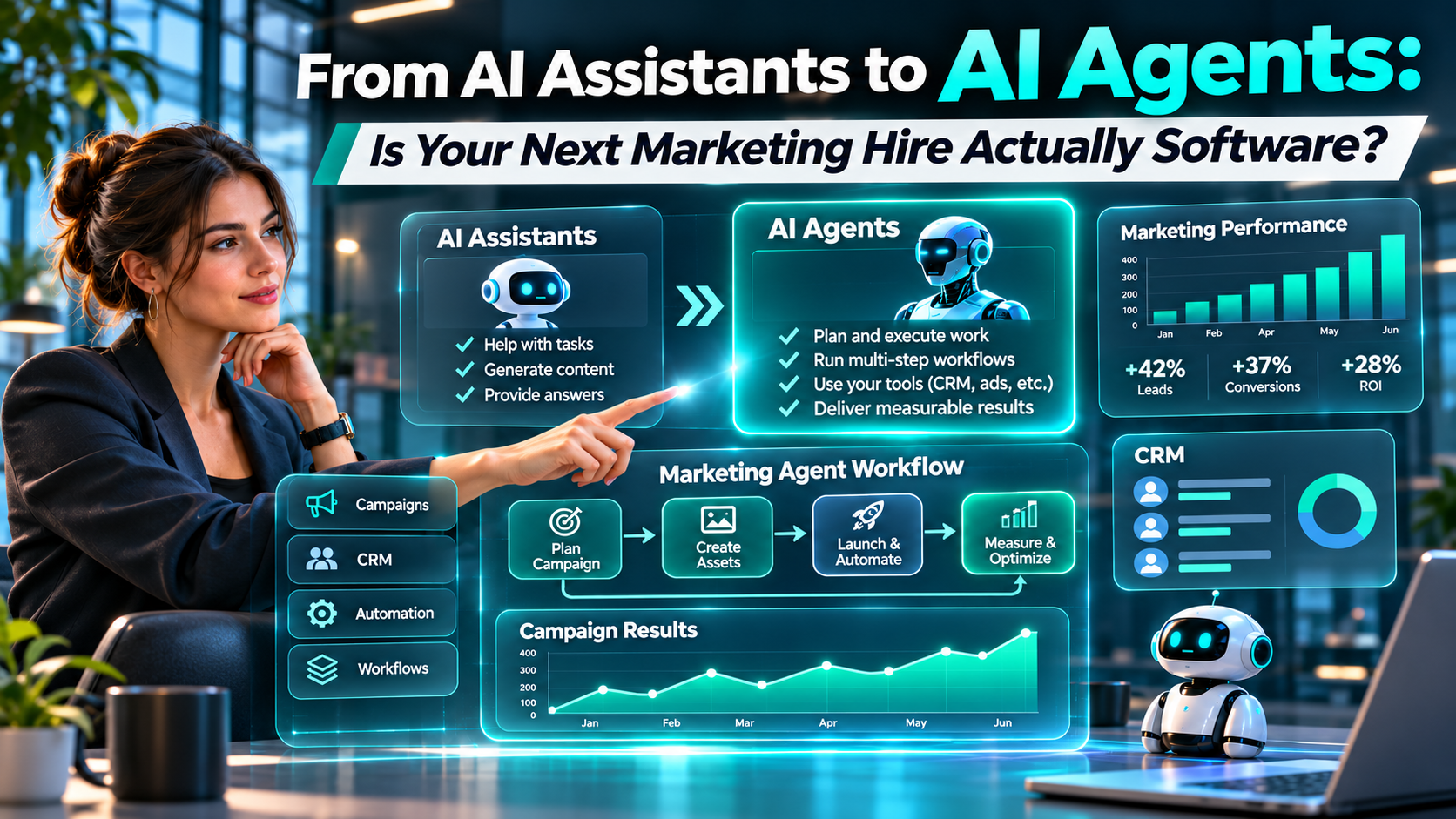

Artificial intelligence is no longer just helping marketers write emails, generate social media captions, or brainstorm campaign ideas. It’s beginning to take action, make operational decisions, execute workflows, and manage increasingly complex marketing responsibilities.
Welcome to the era of AI agents, where software is evolving from a helpful assistant into something that resembles a digital member of your marketing team.
For small businesses, entrepreneurs, and growing companies in St. Louis, Missouri, this evolution presents an intriguing question: What if your next marketing hire isn’t a person, but an AI-powered system capable of handling repetitive tasks, coordinating campaigns, and supporting customer engagement around the clock?
It’s a compelling proposition, particularly for businesses navigating rising operational costs, limited marketing budgets, and growing pressure to deliver personalized customer experiences.
But there’s an important distinction between AI that helps you work and AI that actually performs work on your behalf.
Understanding that difference could fundamentally change how businesses approach digital marketing, workforce development, and sustainable growth.
In this article, we’ll explore the transition from AI assistants to autonomous AI agents, how agentic marketing works, where businesses can realistically deploy these technologies, and why the most successful organizations will likely combine artificial intelligence with human creativity, strategic thinking, and relationship-building.
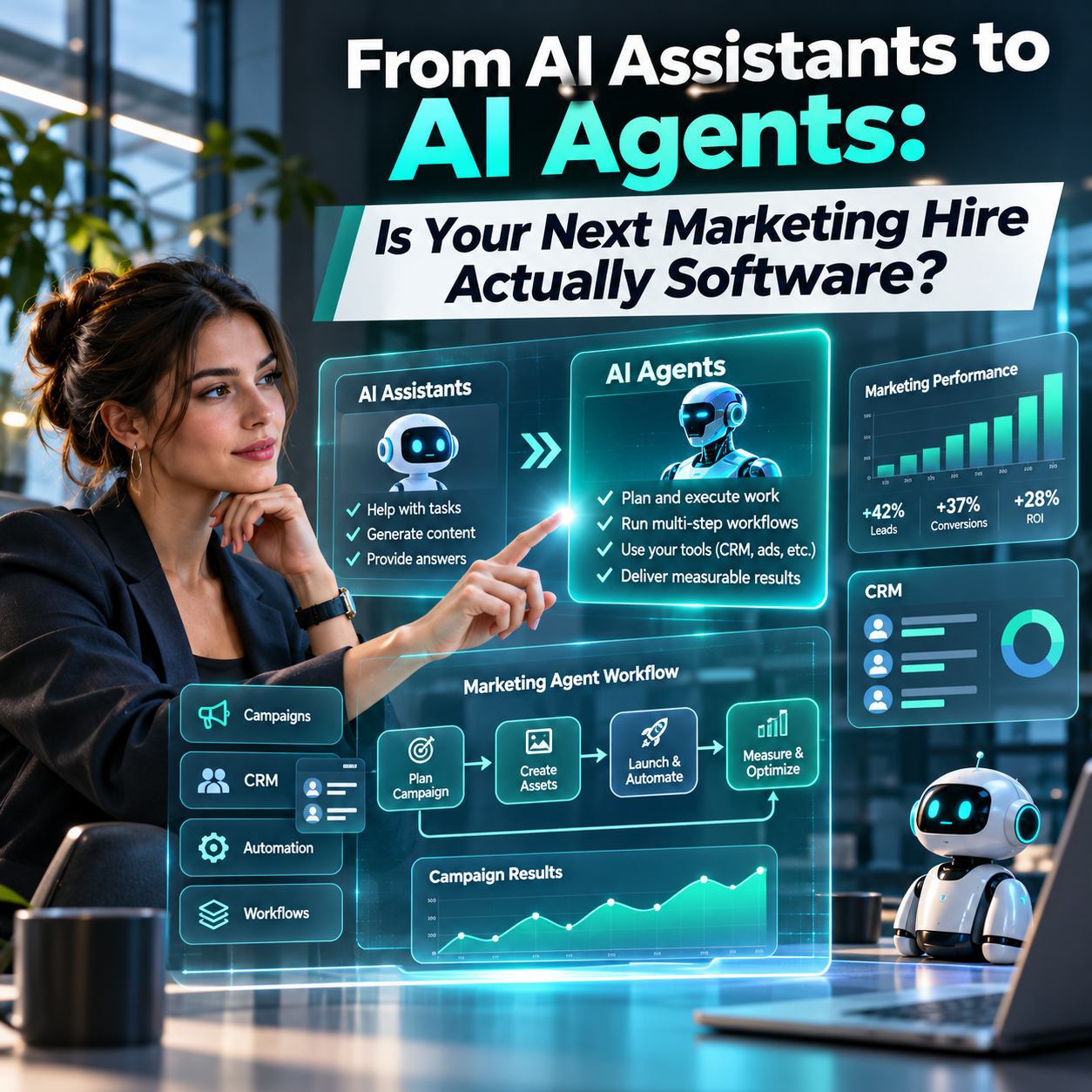
Although the terms are frequently used interchangeably, AI assistants and AI agents serve different purposes.
Traditional AI assistants are primarily reactive. They respond to prompts, answer questions, generate content, and help users complete specific tasks.
Popular examples include ChatGPT, Microsoft Copilot, and Google Gemini.
A marketing professional might ask an AI assistant to write five LinkedIn posts, summarize website analytics, develop an email campaign, or brainstorm blog topics.
The assistant generates an output, but the human generally remains responsible for implementing the recommendations, publishing content, and coordinating subsequent actions.
AI assistants help people accomplish tasks more efficiently, but they typically rely on human direction to move work forward.
AI agents take this concept further.
An AI agent is a software system designed to pursue defined objectives, evaluate information, use connected tools, and execute actions within established boundaries.
Instead of simply generating an email, an AI agent might identify an appropriate customer segment, prepare personalized messages, schedule approved communications, update customer relationship management records, and report campaign performance.
Depending on its configuration, an agent may also recognize when a task requires human approval or additional information.
Consider the difference:
AI assistant: “Here are five ideas for improving your lead generation strategy.”
AI agent: “I’ve analyzed your approved CRM data, identified leads that meet your qualification criteria, prepared follow-up messages, and queued them for your review.”
The distinction isn’t necessarily the sophistication of the language model. It’s the system’s ability to interact with tools, maintain workflow context, and take authorized actions.
This is the foundation of agentic AI in marketing, an emerging approach that could reshape how businesses organize and execute their marketing operations.
Marketing has become increasingly complex.
Businesses must maintain visibility across search engines, social media platforms, email marketing channels, websites, customer databases, and emerging AI-powered discovery experiences.
Meanwhile, customers expect relevant messaging, quick responses, and seamless interactions.
For smaller organizations, managing these responsibilities can stretch available resources.
AI agents offer a potential solution by connecting individual marketing activities into more coordinated workflows.
Small businesses often operate without dedicated teams for content creation, analytics, customer acquisition, and marketing automation.
A single entrepreneur or marketing manager may handle responsibilities that larger organizations distribute across multiple departments.
AI agents can reduce the administrative burden associated with repetitive tasks, freeing employees to focus on strategic priorities.
Customer relationship management platforms, analytics systems, advertising tools, and marketing automation software increasingly support integrations and AI-powered capabilities.
These connections create opportunities for agents to work across multiple systems instead of operating within isolated applications.
For example, an AI agent might use website engagement data to identify potential leads, update a CRM record, and prepare a follow-up workflow.
Generic marketing campaigns are becoming less effective at standing out in crowded digital environments.
Businesses need to understand customer interests, purchasing behavior, and engagement patterns to deliver more relevant experiences.
AI agents can help organize and interpret this information, supporting personalization without requiring every interaction to be manually coordinated.
However, personalization must still respect customer consent, privacy requirements, and communication preferences.
Hiring additional employees can be essential for business growth, but it also introduces recruitment, training, management, and compensation costs.
AI-powered marketing automation can provide additional operational capacity without requiring a proportional increase in staffing.
That doesn’t make AI a universal substitute for employees. It makes AI a potentially valuable component of a more scalable business model.
Practical applications for small businesses and growing marketing teams
1. Lead Qualification and Follow-Up
AI agents can evaluate inbound inquiries against predefined qualification criteria, categorize prospects, prepare personalized follow-ups, and update CRM records. This can help sales teams prioritize promising opportunities.
2. Content Marketing Coordination
Agents can support keyword research, organize editorial calendars, develop content briefs, prepare drafts, and coordinate approval workflows. Human review remains important for factual accuracy, brand voice, and originality.
3. Social Media Management
AI agents can monitor approved social media metrics, organize publishing schedules, identify engagement patterns, and recommend content adjustments. Sensitive customer interactions should still receive appropriate human oversight.
4. Email Marketing Automation
Agents can help segment subscriber lists, prepare email sequences, evaluate engagement, and suggest improvements. Properly configured systems can coordinate workflows while honoring unsubscribe requests and consent requirements.
5. SEO and Website Optimization
AI agents can monitor technical SEO issues, identify content gaps, analyze search performance, and recommend website improvements. They can also support structured content development for traditional search and AI-powered discovery.
6. Customer Support and Engagement
Connected AI systems can answer common questions, route inquiries, help schedule appointments, and escalate complicated requests. This can improve responsiveness without requiring employees to monitor every incoming message.
7. Marketing Analytics and Reporting
Agents can gather data from connected platforms, assemble performance reports, identify unusual changes, and recommend areas for investigation. This can help business owners spend less time compiling reports and more time making decisions.
These applications are not equally autonomous or reliable. Their capabilities depend on the software, integrations, permissions, data quality, and oversight built into each deployment.
This is where the conversation becomes especially interesting.
Traditionally, when a business reaches operational capacity, leadership considers hiring another employee, outsourcing responsibilities, or engaging a marketing agency.
AI introduces a fourth possibility: expanding capacity through intelligent software.
Imagine a growing St. Louis service business struggling to manage incoming leads, follow up with prospects, maintain consistent social media activity, and monitor marketing performance.
The owner might initially believe hiring a full-time marketing coordinator is the only practical solution.
However, an integrated AI workflow could potentially handle portions of those responsibilities.
For example, a properly configured system might:
Capture inquiries from website forms.
Organize lead information inside a CRM.
Classify prospects using approved criteria.
Prepare personalized follow-up communications.
Notify a salesperson when a qualified prospect needs attention.
Generate weekly reports highlighting lead volume and conversion trends.
This doesn’t eliminate the need for human involvement.
Instead, it allows people to concentrate on relationship-building, consultative selling, creative problem-solving, and strategic decisions.
The real opportunity isn’t replacing your marketing team. It’s increasing what your marketing team can accomplish.
For many small businesses, the most practical first step may be automating one repetitive workflow rather than deploying an entirely autonomous marketing operation.
Despite rapid advances in artificial intelligence, effective marketing still requires distinctly human capabilities.
Technology can analyze customer behavior, process large datasets, and execute structured workflows. But marketing also depends on empathy, creativity, trust, and understanding the emotional motivations behind purchasing decisions.
Here’s how the responsibilities compare.
Marketing responsibility | AI agents | Human professionals |
|---|---|---|
Data analysis | Process and summarize information | Interpret business implications |
Content creation | Research, outline, and draft | Develop original perspectives and brand voice |
Lead management | Organize and prioritize prospects | Build relationships and close complex deals |
Campaign execution | Coordinate approved workflows | Set objectives and creative direction |
Customer engagement | Handle routine interactions | Manage sensitive and nuanced conversations |
Marketing strategy | Surface patterns and recommendations | Make strategic decisions and establish priorities |
The most effective approach is often a hybrid model.
An AI agent might recognize that website conversion rates are declining, but an experienced marketing strategist must determine whether the underlying issue involves messaging, audience targeting, user experience, or competitive positioning.
Similarly, AI can generate hundreds of social media posts, but volume alone doesn’t create an authentic brand identity.
Customers connect with stories, experiences, values, and perspectives that resonate with their needs.
This is why human-centric marketing becomes more important as AI adoption increases.
For businesses operating in St. Louis, St. Charles, Chesterfield, O’Fallon, and surrounding Missouri communities, AI-powered marketing systems offer opportunities to compete more efficiently.
Local companies often face unique challenges, including limited marketing resources, competitive regional markets, and the need to maintain strong customer relationships.
AI agents can support these objectives without requiring businesses to abandon their local identity.
A St. Louis home services company could use an AI-enabled workflow to organize inquiries from its website, categorize service requests, and prepare appointment follow-ups.
This can help reduce the risk of missed opportunities while allowing employees to focus on delivering services.
A professional services company in St. Charles could use AI tools to monitor website performance, identify opportunities for locally relevant content, and flag outdated business information.
As AI-powered search experiences evolve, businesses also need clear, credible, well-structured website content that accurately explains their expertise, services, and geographic relevance.
AI agents can assist with monitoring and recommendations, but they cannot guarantee rankings, citations, or inclusion in AI-generated answers.
A Chesterfield-based business could use connected customer data to identify clients who may benefit from a service reminder, follow-up appointment, or relevant educational content.
With appropriate consent and safeguards, these workflows can help strengthen customer relationships and encourage repeat business.
An O’Fallon business owner could receive recurring summaries of website traffic, lead activity, and campaign performance without manually collecting data from multiple dashboards.
The resulting visibility can support faster, better-informed decisions.
For local businesses, the objective should not be automation for its own sake. It should be improving customer experience, operational consistency, and measurable business performance.
Although AI agents offer significant opportunities, businesses should avoid assuming that autonomy automatically produces better results.
An agent that can take action can also make mistakes at scale.
AI systems can misunderstand instructions, misinterpret data, or generate inaccurate content.
An agent responsible for customer communications could potentially distribute incorrect information if proper review processes are missing.
Businesses should establish clear rules governing which actions require approval.
Marketing systems frequently contain customer names, contact details, purchase histories, and other sensitive information.
Connecting AI agents to these systems introduces additional security considerations.
Organizations should limit access to necessary information, review vendor data practices, and implement appropriate security controls.
An automated response that sounds inappropriate, insensitive, or inconsistent with company values can damage customer trust.
Businesses should maintain oversight of public-facing communications, particularly when handling complaints, sensitive topics, or unusual situations.
Not every marketing interaction should be automated.
Customers may appreciate quick responses to routine questions, but complex purchasing decisions and meaningful business relationships often benefit from direct human involvement.
The goal should be to remove unnecessary friction, not remove humanity from the customer experience.
AI tools can create additional costs through subscriptions, integrations, implementation, usage fees, and ongoing maintenance.
A business that deploys several disconnected AI products may end up with more complexity rather than greater efficiency.
Before adopting AI agents, organizations should identify a specific business problem and determine how success will be measured.
Businesses don’t need to rebuild their entire marketing infrastructure to begin experimenting with AI agents.
A phased implementation strategy is generally more practical.
Step 1: Audit Your Existing Marketing Workflows
Identify repetitive activities consuming significant time, such as lead entry, reporting, appointment reminders, and content coordination. Prioritize tasks with clear instructions and measurable outcomes.
Step 2: Select One High-Impact Use Case
Start with a manageable workflow rather than attempting to automate everything simultaneously. Lead qualification or weekly marketing reporting may be suitable starting points.
Step 3: Evaluate Your Technology Infrastructure
Determine whether your CRM, website, email marketing platform, and analytics tools support the necessary integrations. Compare agentic capabilities with conventional rule-based automation before investing.
Step 4: Establish Human Oversight
Define approval requirements, access permissions, escalation procedures, and quality standards. Begin with read-only or draft-only capabilities before authorizing consequential actions.
Step 5: Measure Results and Expand Carefully
Monitor time saved, qualified leads generated, response times, conversion rates, operating costs, and error rates. Expand automation only when performance justifies additional investment.
This approach allows businesses to develop practical AI capabilities while maintaining control over their marketing operations.
One of the biggest mistakes businesses can make is evaluating AI solely by how much content it generates or how many tasks it completes.
Activity doesn’t necessarily translate into business value.
A marketing agent that produces fifty social media posts but generates no meaningful engagement or qualified leads may provide little return.
Instead, organizations should evaluate AI investments against measurable operational and commercial outcomes.
Important metrics include:
Time savings: How many employee hours are redirected from repetitive activities?
Cost efficiency: How do implementation and ongoing expenses compare with the value created?
Lead response time: Are prospective customers receiving faster, more consistent responses?
Lead quality: Are sales teams receiving more relevant opportunities?
Conversion performance: Are more qualified prospects becoming customers?
Customer satisfaction: Are automated experiences improving or weakening relationships?
Accuracy and reliability: How frequently do agents require correction or intervention?
For example, consider a business that spends 20 hours per month preparing marketing reports.
If an AI-enabled workflow reduces that requirement to five hours while maintaining acceptable accuracy, the business saves 15 hours monthly.
At an illustrative internal labor value of $50 per hour, that represents $750 in monthly capacity value before accounting for software, setup, review, and maintenance costs.
Those savings become meaningful when the reclaimed time is redirected toward activities that support revenue growth or customer retention.
The value of AI agents should be measured by business outcomes, not simply automation volume.
As artificial intelligence becomes more capable, businesses will face increasing pressure to reconsider how marketing responsibilities are distributed.
Some routine functions will become easier to automate. Other responsibilities will evolve as professionals learn to supervise AI systems, interpret their outputs, and coordinate technology-driven workflows.
New skills will become increasingly valuable, including AI workflow design, data interpretation, automation management, strategic content development, and technology governance.
At the same time, traditional marketing fundamentals will remain essential.
Businesses will still need compelling value propositions, differentiated positioning, meaningful customer relationships, and trustworthy brands.
An AI agent cannot independently determine what makes a company genuinely worth choosing. It can help analyze market information and test ideas, but business leaders must ultimately define their organization’s direction.
This creates an important competitive opportunity.
Companies that combine operational efficiency with authentic human engagement may be better positioned than organizations relying exclusively on manual processes or indiscriminate automation.
The question isn’t whether artificial intelligence will influence the future of marketing.
It already is.
The more important question is whether businesses will implement AI thoughtfully enough to improve performance without sacrificing the qualities that make their brands valuable.
The transition from AI assistants to AI agents represents a meaningful change in how businesses can approach marketing execution.
Instead of treating AI as a standalone tool for generating content, organizations can begin exploring systems that coordinate activities, analyze information, and support decisions across their marketing infrastructure.
For small businesses, this could mean faster customer responses, more consistent follow-up, reduced administrative work, and better visibility into marketing performance.
But successful implementation requires more than purchasing software.
It requires clear objectives, dependable data, thoughtful workflow design, responsible governance, and a continued commitment to human-centric customer experiences.
Businesses that rush into automation without these foundations risk creating more problems than they solve.
Those that adopt AI strategically can build marketing operations that are more responsive, efficient, and adaptable.
The idea of hiring an AI agent instead of another marketing employee makes for an attention-grabbing headline.
However, the larger opportunity is more nuanced.
AI agents aren’t simply digital replacements for people. They are emerging tools that can expand organizational capabilities, automate defined responsibilities, and create additional capacity for strategic work.
For St. Louis businesses seeking sustainable growth, the opportunity lies in understanding which tasks technology should handle and which responsibilities benefit most from human expertise.
The companies that succeed won’t necessarily be those deploying the greatest number of AI agents.
They’ll be the ones using AI to create better customer experiences, stronger marketing performance, and more meaningful business relationships.
Your next marketing hire might be software. But the strategy, creativity, and human connection behind your business will remain essential.
At Razor Sharp Digital, we believe the future of digital marketing combines intelligent technology with human-centered strategy.
Whether you’re exploring AI marketing automation, improving your lead generation processes, modernizing your website, or developing a more scalable digital marketing approach, the first step is understanding where technology can create meaningful value for your business.
Learn about strategic human marketing and how it can benefit your business.
Download for FREE TODAY!
Get all the latest content, news, and digital marketing insights to help you humanize your brand.
Join thousands getting our insider updates learning how to grow their business using AI + human centricity.
(P.S. We will NEVER sell your personal data to anyone like the other guys do)
Your company needs humanization and personalization in order for it to thrive and grow. Our systematic, strategic, and seasoned approach will help you thrive and grow. Let’s discuss ways we can help your business become more human-centric so you can dominate.
The main entrance to our primary domain.
The 10 commandments that we live by, practice by, and service our customers. The Holy Grail of our entire philosophy if you’d like to call it that.
The digital and social media vault where we share our insights, experiences, and advice on how to humanize your brand so you can thrive and grow.
A full breakdown of all of our service offerings in the digital and social media spectrum.
How it all started, our story, and who is behind this human marketing agency.
Are you a natural-born superstar? Looking to make a global impact? We are always seeking aspiring rockstars to join our team.
The best way to get in touch with us about your digital and social media needs.