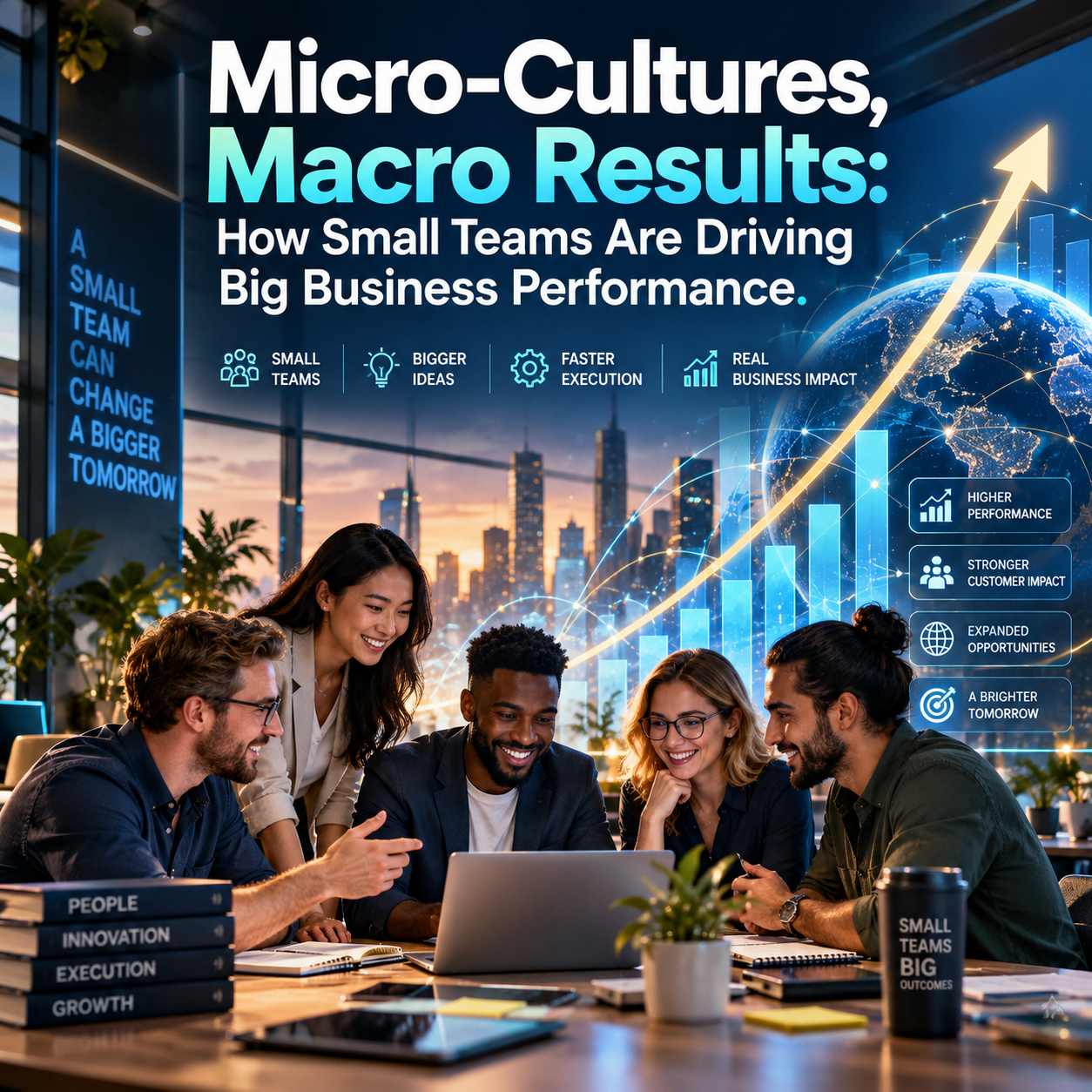





Welcome to the era of micro-cultures, where the smallest organizational communities can have the biggest impact on productivity, employee engagement, innovation, and business growth.
For decades, companies have invested heavily in establishing a unified corporate culture. Mission statements, company values, employee handbooks, and organizational policies were designed to create consistency across the workforce. While these elements remain important, today’s evolving workplace demands something more adaptable, personal, and human-centered.
Employees don’t experience company culture exclusively through corporate messaging. They experience it through their immediate colleagues, direct managers, daily interactions, and the environment surrounding their work.
That’s where micro-cultures come into play.
As businesses navigate hybrid work environments, artificial intelligence, changing employee expectations, and increasing competitive pressures, small team cultures are emerging as powerful drivers of organizational performance.
For businesses in St. Louis and beyond, understanding how to cultivate effective micro-cultures could become a meaningful competitive advantage.
A micro-culture is a distinct set of shared behaviors, values, communication practices, and working relationships that develops within a smaller group inside a larger organization.
These groups might include marketing departments, sales teams, project teams, customer service units, leadership groups, or cross-functional teams collaborating on specific business objectives.
Although these teams operate within the broader corporate culture, they develop their own identities based on shared experiences, leadership styles, responsibilities, and interpersonal relationships.
For example, a company’s marketing department might prioritize creativity, experimentation, and rapid collaboration. Meanwhile, its finance department might emphasize precision, accountability, and structured decision-making.
Both departments contribute to the same organizational mission, but their daily cultures naturally differ.
Micro-cultures aren’t necessarily a rejection of corporate culture. They’re an extension of it.
When managed effectively, they allow organizations to maintain shared values while giving individual teams the flexibility to operate in ways that maximize their performance.
Corporate culture | Micro-culture |
|---|---|
Organization-wide values and mission | Team-specific behaviors and practices |
Established by organizational leadership | Shaped by managers and team members |
Emphasizes company-wide alignment | Emphasizes team-level collaboration |
Provides consistent expectations | Adapts to specific team needs |
Influences organizational identity | Influences daily employee experiences |
The most successful organizations recognize that these two cultural dimensions should complement rather than compete with each other.
The growing importance of micro-cultures reflects fundamental changes in how businesses operate and how employees define meaningful work.
Traditional organizational structures often relied on centralized leadership, rigid hierarchies, and standardized procedures. Modern businesses increasingly require flexibility, faster decision-making, and greater employee participation.
Several trends are accelerating this transformation.
As remote and hybrid work arrangements become established across many industries, employees increasingly develop their strongest professional connections within their immediate teams.
Daily video meetings, collaborative platforms, project discussions, and informal digital conversations shape their workplace experience.
An employee working remotely might rarely interact with senior executives but communicate with their direct team multiple times each day.
Consequently, the quality of those immediate relationships can have a substantial influence on engagement, motivation, and job satisfaction.
Organizations that intentionally strengthen team-level cultures can create a greater sense of belonging, even when employees are geographically dispersed.
Today’s workforce increasingly values meaningful contributions, professional development, flexibility, and supportive leadership.
Employees want to understand how their work contributes to organizational success.
Smaller teams often provide greater visibility into individual contributions and create opportunities for employees to participate directly in decision-making.
Rather than feeling like another employee within a large corporate structure, individuals can develop a stronger sense of ownership over outcomes.
This sense of ownership can encourage accountability, creativity, and commitment.
Artificial intelligence is transforming how businesses manage information, automate processes, analyze data, and deliver customer experiences.
However, AI implementation isn’t simply a technological challenge.
It’s also a cultural one.
Teams must learn how to collaborate with intelligent systems, experiment with new workflows, and continuously develop their capabilities.
Micro-cultures that encourage curiosity, knowledge sharing, and responsible experimentation may be better positioned to integrate AI into their daily operations.
The organizations that benefit most from AI won’t necessarily be those with the largest technology budgets. They’ll be those whose employees can adapt effectively to new ways of working.
Markets change quickly. Customer expectations evolve. Competitors introduce new technologies, services, and business models.
Organizations that rely exclusively on centralized decision-making can struggle to respond efficiently.
Small, empowered teams can identify challenges, test solutions, and implement improvements without waiting for every decision to move through multiple management layers.
When supported by clear organizational goals and appropriate oversight, this agility can improve responsiveness and execution.
The value of micro-cultures extends beyond employee satisfaction.
When thoughtfully developed, they can influence measurable business outcomes, including productivity, customer experience, innovation, retention, and operational efficiency.
1. Higher Employee Engagement and Productivity
Employees who trust their colleagues and understand their responsibilities can collaborate more effectively. Clear expectations, constructive feedback, and shared accountability help reduce confusion and improve execution.
2. Faster Innovation and Problem-Solving
Small teams can create environments where employees feel comfortable sharing unconventional ideas. When psychological safety is present, individuals are more willing to challenge assumptions, experiment, and learn from setbacks.
3. Stronger Employee Retention
Supportive managers, meaningful relationships, and opportunities for professional growth can influence an employee’s decision to remain with an organization. Positive team cultures can strengthen these experiences.
4. Improved Customer Experiences
Teams that communicate effectively and take ownership of outcomes are better equipped to resolve customer problems. Strong internal collaboration can translate into more consistent external service.
These benefits are not automatic. A small team with poor leadership can become just as dysfunctional as a large department. The difference lies in the intentional behaviors and systems that shape its culture.
Leadership is one of the most influential factors in determining whether a micro-culture becomes an organizational asset or liability.
While executive leadership establishes company-wide direction, team managers translate organizational values into everyday experiences.
Employees observe how their managers communicate, handle disagreements, recognize achievements, and respond to mistakes.
These behaviors become powerful cultural signals.
A manager who encourages open communication and accepts constructive criticism can help establish trust.
Conversely, a manager who discourages questions, micromanages employees, or assigns blame can create an environment where individuals avoid taking initiative.
Lead with transparency: Explain decisions, communicate expectations, and share relevant organizational information.
Encourage ownership: Give employees meaningful responsibility and the authority needed to accomplish their work.
Recognize contributions: Celebrate individual accomplishments and collective achievements.
Create psychological safety: Encourage respectful disagreement, thoughtful experimentation, and honest conversations.
Demonstrate consistency: Align leadership behavior with the values employees are expected to uphold.
Strong micro-cultures rarely develop through motivational speeches alone.
They emerge from repeated leadership behaviors that reinforce trust, respect, and accountability.
One of the most important characteristics of effective micro-cultures is psychological safety.
Psychological safety refers to a shared belief that team members can speak openly, ask questions, acknowledge mistakes, and contribute ideas without unnecessary fear of embarrassment or punishment.
This doesn’t mean eliminating accountability or avoiding difficult conversations.
Instead, it means creating an environment where constructive disagreement and continuous improvement are encouraged.
Consider two teams facing the same operational challenge.
In the first team, employees hesitate to report problems because they fear negative consequences.
In the second team, employees openly identify obstacles, discuss potential solutions, and collaborate on improvements.
The second team has a greater opportunity to identify issues early and prevent them from escalating.
For businesses seeking sustainable performance, psychological safety should be treated as an operational capability rather than simply an employee wellness initiative.
It supports communication, learning, and the responsible exchange of ideas.
As automation and artificial intelligence become more prevalent, human-centered organizational practices are becoming increasingly important.
Technology can accelerate workflows, process information, and automate repetitive tasks.
However, effective collaboration still depends on qualities such as empathy, judgment, trust, creativity, and interpersonal understanding.
Micro-cultures provide an environment where these human capabilities can be developed and reinforced.
For example, an AI-powered marketing team might use automation to analyze campaign performance, generate reporting insights, and streamline content production.
Yet the team’s culture determines how members interpret those insights, challenge assumptions, and make strategic decisions.
Technology can improve efficiency, but culture influences how effectively people use that technology.
Businesses that combine intelligent automation with strong human relationships may be better equipped to innovate without sacrificing employee engagement or customer trust.
This is particularly relevant for small and midsize businesses that must balance limited resources with increasing demands for performance.
Small businesses throughout St. Louis, St. Charles, Chesterfield, O’Fallon, and surrounding Missouri communities face a unique combination of opportunities and challenges.
They compete for talented employees, manage operating costs, respond to changing customer expectations, and seek sustainable growth.
Unlike large corporations, many local businesses don’t have extensive human resources departments or dedicated organizational development teams.
Fortunately, developing effective micro-cultures doesn’t necessarily require significant financial investment.
In fact, smaller organizations may have structural advantages.
Employees in small businesses often interact directly with owners, managers, and colleagues across multiple functions.
These relationships create opportunities for more personalized communication, immediate feedback, and meaningful collaboration.
A St. Louis marketing agency with eight employees, for example, may be able to implement new collaborative practices much faster than a corporation with thousands of workers.
The key is ensuring those relationships are supported by clear expectations and healthy boundaries.
Small teams often have fewer management layers, allowing them to respond quickly to customer feedback and operational challenges.
A local service company might discover that customers prefer faster communication through text messaging.
Rather than navigating a lengthy approval process, its customer service team may be able to pilot a revised communication workflow, measure satisfaction, and refine the approach.
That responsiveness can become a competitive differentiator.
For small businesses competing with larger employers, workplace culture can influence recruitment and retention.
Employees who feel respected, supported, and connected to their colleagues may be more likely to recommend their organization to others.
Positive employee experiences can also influence how customers and prospective employees perceive the business.
For St. Louis organizations seeking long-term growth, investing in team culture can complement traditional recruitment, branding, and marketing efforts.
Creating a productive micro-culture requires intentional leadership, consistent communication, and measurable objectives.
The following strategies can help organizations establish team environments that support both employee well-being and business performance.
Every team should understand why it exists and how its work contributes to broader organizational goals.
A clear purpose creates direction and helps employees connect daily responsibilities with meaningful outcomes.
For example, a marketing team’s purpose might be to generate qualified opportunities and strengthen brand awareness, rather than simply publish content.
Teams should agree on how members communicate, collaborate, manage deadlines, and resolve disagreements.
These expectations should reflect company-wide values while addressing the team’s specific responsibilities.
Written team agreements can help reinforce consistency and accountability.
Micromanagement can discourage initiative and slow execution.
Give employees appropriate decision-making authority based on their responsibilities, capabilities, and organizational requirements.
Autonomy should always be accompanied by clear performance expectations.
Constructive feedback shouldn’t be reserved for annual performance reviews.
Regular conversations help employees understand their progress, identify challenges, and develop professionally.
Team leaders can introduce brief weekly check-ins, monthly development discussions, and collaborative project reviews.
Cross-functional projects, brainstorming sessions, and shared problem-solving exercises can strengthen relationships.
However, collaboration should be purposeful.
Excessive meetings and unnecessary communication can undermine productivity.
Effective teams balance collaboration with focused individual work.
Recognition reinforces the behaviors that contribute to success.
Celebrate completed projects, improved customer outcomes, innovative solutions, and examples of effective teamwork.
Recognition doesn’t always require financial rewards.
Specific, timely appreciation can communicate that employees’ contributions matter.
Culture shouldn’t be evaluated exclusively through employee opinions or anecdotal observations.
Organizations should examine both employee experiences and operational performance.
Potential indicators include engagement feedback, employee retention, project completion rates, customer satisfaction, and quality of work.
By reviewing these measures consistently, leaders can identify opportunities for improvement.
A common challenge with organizational culture initiatives is demonstrating their financial and operational value.
Although culture itself can be difficult to quantify, organizations can measure outcomes associated with effective team environments.
Performance indicator | What it helps evaluate |
|---|---|
Employee engagement | Motivation, belonging, and team satisfaction |
Employee retention | Workforce stability and turnover patterns |
Project completion rates | Execution consistency and productivity |
Customer satisfaction | Service quality and customer experience |
Employee innovation | New ideas, experiments, and improvements |
Internal collaboration | Communication effectiveness and coordination |
Revenue per employee | Output relative to workforce size |
These metrics should be interpreted together rather than treated as definitive proof that culture caused a particular outcome.
For example, improved customer satisfaction might result from stronger teamwork, better technology, additional training, or a combination of factors.
Businesses can gain more useful insights by comparing performance trends over time, collecting employee feedback, and examining changes in team practices.
The objective is to establish a connection between intentional cultural improvements and meaningful organizational outcomes.
Although micro-cultures offer considerable potential, they also introduce risks when teams become disconnected from the larger organization.
An overly independent team may develop practices that conflict with company values, resist collaboration, or prioritize departmental success over organizational goals.
These problems can create information silos, inconsistent customer experiences, and internal competition.
For example, a sales team focused exclusively on closing deals might make commitments that the operations team cannot realistically fulfill.
Without shared expectations and cross-functional communication, individual team success can create broader organizational challenges.
Businesses should establish a balance between team autonomy and organizational alignment.
Leadership can accomplish this by maintaining shared company values, establishing cross-departmental objectives, encouraging knowledge sharing, and regularly reviewing team performance.
Micro-cultures should strengthen the organization rather than fragment it.
Looking toward 2027 and beyond, businesses will continue navigating changes in technology, workforce expectations, and competitive dynamics.
Artificial intelligence will likely assume a greater role in administrative processes, analytics, communication, and decision support.
Hybrid collaboration will continue influencing how employees interact.
Organizations will also face ongoing pressure to innovate while maintaining operational efficiency.
Within this environment, micro-cultures offer a practical approach to building adaptable, resilient teams.
Rather than relying exclusively on top-down cultural initiatives, businesses can empower smaller groups to develop effective working relationships aligned with organizational objectives.
The future of workplace culture may be less about enforcing identical behaviors across every department and more about establishing shared principles that allow different teams to thrive.
The strongest organizations will recognize that consistency of purpose doesn’t require uniformity of working style.
Organizational success is rarely determined by strategy, technology, or financial resources alone.
It also depends on how effectively people work together.
Micro-cultures demonstrate that meaningful business performance often begins with everyday interactions between colleagues, managers, and teams.
When employees experience trust, autonomy, accountability, and shared purpose, they are better positioned to collaborate, innovate, and contribute to organizational growth.
For small businesses and growing organizations throughout St. Louis, cultivating strong micro-cultures presents an opportunity to improve employee experiences while strengthening operational performance.
The challenge isn’t simply creating a positive workplace environment.
It’s building team cultures that consistently translate shared values into measurable results.
Because sometimes, the biggest business transformations begin with the smallest teams.
At Razor Sharp Digital, we believe sustainable business growth requires more than adopting new technologies or implementing the latest marketing trends.
It requires a strategic combination of human creativity, effective collaboration, intelligent technology, and customer-centered experiences.
Whether your St. Louis business is looking to strengthen its digital presence, improve customer engagement, or develop a more effective growth strategy, we’re here to help.
Ready to take your business performance to the next level?
Connect with Razor Sharp Digital and discover how a human-centric digital strategy can help your business grow.