




The way consumers discover businesses online is undergoing one of the most significant transformations since the introduction of Google Search. For decades, businesses have invested in search engine optimization (SEO) to improve their rankings, attract website visitors, and generate qualified leads. But artificial intelligence is changing how people search, evaluate, and ultimately choose the companies they do business with.
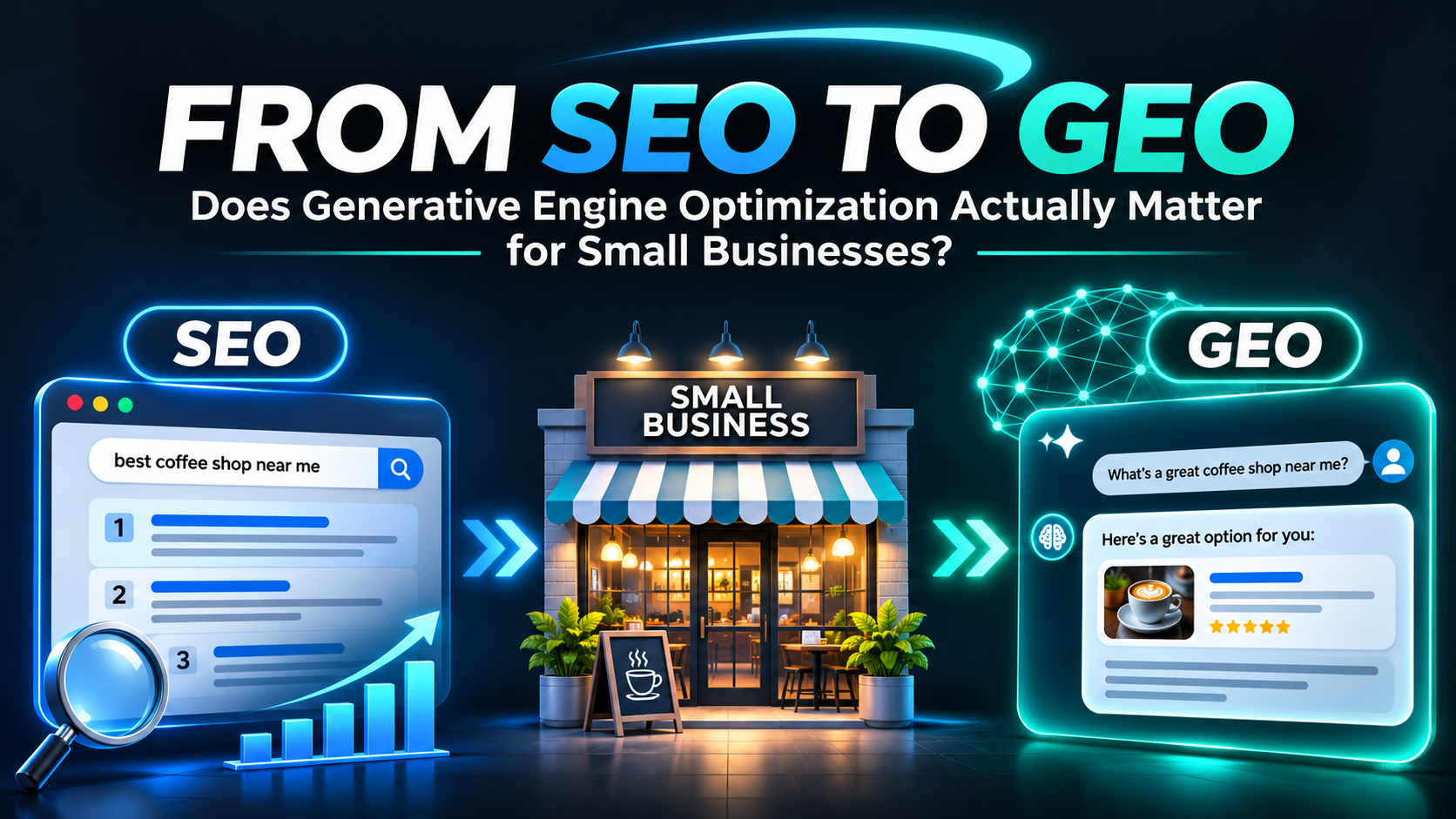

Today, consumers aren’t just typing keywords into Google. They’re asking ChatGPT for recommendations, using Google’s AI Overviews to compare services, and turning to AI-powered search platforms like Perplexity and Gemini for answers.
This shift has introduced a new term into the digital marketing conversation: Generative Engine Optimization (GEO).
For small businesses, however, the question isn’t simply whether GEO is the next big marketing trend. It’s whether investing in GEO will actually produce measurable business results or simply add another expense to an already stretched marketing budget.
Does GEO genuinely matter for small businesses, or is it another digital marketing buzzword?
The answer requires understanding how AI-powered search works, how it differs from traditional SEO, and what small businesses should prioritize to remain competitive in an increasingly AI-driven marketplace.
Generative Engine Optimization, commonly referred to as GEO, is the process of improving a business’s visibility and representation within AI-generated search responses.
Unlike traditional SEO, which primarily focuses on improving website rankings in search engine results pages, GEO seeks to increase the likelihood that AI-powered platforms will discover, reference, cite, or recommend a business when responding to relevant questions.
Consider the difference between these two searches:
Traditional Google Search:
“Best digital marketing agency in St. Louis”
A conventional search results page might display local business listings, organic website results, advertisements, and directories.
AI-Powered Search:
“Which digital marketing agencies in St. Louis specialize in helping small businesses improve their online presence without spending heavily on advertising?”
An AI-powered platform may generate a conversational response discussing several agencies, their services, and factors that distinguish them.
Instead of simply displaying links, the platform may synthesize information from multiple sources into a single answer.
This changes the competitive landscape.
Businesses are no longer competing exclusively for positions on search results pages. They’re also competing to become credible sources within AI-generated answers.
However, an important distinction exists: AI-generated recommendations aren’t guaranteed to be accurate, comprehensive, or based on the same sources every time.
GEO is therefore about improving discoverability and credibility, not controlling what an AI platform says.
Although SEO and GEO share many foundational principles, their immediate objectives differ.
Traditional SEO | Generative Engine Optimization |
|---|---|
Improves organic search rankings | Improves visibility in AI-generated responses |
Targets keywords and search intent | Targets conversational questions and contextual relevance |
Measures rankings, clicks, and organic traffic | Examines citations, mentions, referrals, and leads |
Prioritizes technical SEO, content, and authority | Builds on technical accessibility, content clarity, and credibility |
Helps users discover websites through search results | Helps users discover businesses through AI-generated answers |
Despite these differences, GEO should not be viewed as a replacement for SEO.
Google’s guidance on generative AI search explicitly reinforces that established SEO best practices remain relevant to AI-powered search experiences.
For small businesses, this is encouraging news.
It means that companies investing in useful content, accessible websites, strong local visibility, and trustworthy digital reputations are already developing many of the assets that can support GEO.
The goal isn’t to abandon SEO. It’s to expand an effective SEO strategy to accommodate how customers increasingly discover information through AI.
Consumers increasingly expect immediate, personalized answers rather than spending time comparing numerous websites.
Imagine a homeowner in St. Charles, Missouri, looking for a roofing contractor.
Instead of searching for “roofing contractors near me” and visiting several websites, that homeowner might ask:
“Who are some reputable roofing contractors around St. Charles that specialize in storm damage and offer financing?”
This question contains multiple layers of intent, including location, service specialization, reputation, and affordability.
AI-powered search experiences can help consumers explore those requirements through a conversation.
For small businesses, the opportunity is significant: a company that communicates its services, expertise, geographic coverage, and differentiators clearly may be easier for relevant search systems to identify and evaluate.
Google reported in August 2026 that AI Overviews had more than 2.5 billion monthly active users, while AI Mode had surpassed one billion monthly users. These are platform adoption figures, not evidence that every small business customer uses AI for purchasing decisions, but they demonstrate the growing scale of AI-assisted discovery.
Historically, small businesses concentrated their organic marketing efforts on Google rankings, local search visibility, and website traffic.
Those channels remain essential.
However, consumers now have additional ways to research businesses through platforms such as:
ChatGPT
Google AI Overviews and AI Mode
Perplexity
Microsoft Copilot
Google Gemini
Each platform may use different methods to retrieve, interpret, and present information.
A business appearing prominently in traditional search results won’t necessarily receive the same visibility across every AI platform.
This creates an emerging challenge for small businesses: maintaining a consistent and credible digital presence across an increasingly fragmented discovery environment.
One of the more consequential developments in AI-powered search is the possibility that consumers can evaluate several businesses without visiting each company’s website.
An AI-generated answer might summarize services, explain differences between providers, and highlight considerations relevant to a purchasing decision.
By the time a consumer visits a website, they may have already narrowed their choices.
This makes brand recognition, reputation, and accurate business information increasingly important.
For small businesses, the strategic question becomes:
Will potential customers recognize and consider your business during the research process, even when they haven’t visited your website yet?
That question extends beyond conventional keyword rankings.
The growing interest in GEO has created a market for agencies, consultants, and software platforms promising improved AI search visibility.
But businesses should distinguish emerging evidence from marketing claims.
A foundational research paper titled GEO: Generative Engine Optimization, published in the 2024 ACM SIGKDD conference proceedings, explored techniques for improving content visibility within generative engine responses.
The researchers reported visibility improvements of up to 40% in their experimental setting, with effectiveness varying by domain and optimization technique.
That finding suggests content presentation can influence how generative systems use information.
However, it doesn’t establish that applying those techniques to a small business website will produce a 40% increase in traffic, leads, or sales.
A 2026 critical survey of GEO research also highlighted limitations in the available evidence, including differences between platforms, inconsistent measurement approaches, and the lack of demonstrated long-term effects on organic discovery and business outcomes.
The practical conclusion?
GEO is a legitimate area of digital marketing development, but businesses should remain cautious about anyone guaranteeing AI citations, recommendations, or revenue growth.
A credible GEO strategy should be built around measurable experimentation rather than promises of instant visibility.
Small businesses don’t necessarily need expensive software or a separate GEO department to begin adapting.
Many of the most useful improvements are extensions of established digital marketing practices.
Before investing heavily in GEO, ensure your website meets fundamental SEO requirements.
That includes mobile-friendly design, crawlable pages, descriptive page titles, clear navigation, relevant content, and strong internal linking.
Technical accessibility matters because AI-powered search experiences often rely on retrieval systems that discover and process web content.
For Google’s AI search features specifically, eligibility depends on existing Search indexing and technical requirements.
A website that search engines struggle to crawl or understand is unlikely to benefit from superficial GEO tactics.
For a small business in St. Louis, the starting point should be a comprehensive website and SEO audit rather than purchasing a new AI optimization subscription.
Traditional keyword-focused content often targets phrases such as “St. Louis SEO services” or “small business website development.”
Those keywords remain valuable, but conversational search creates opportunities for more detailed content.
For example:
How much should a small business spend on digital marketing in St. Louis?
Is local SEO worth it for a service-based business?
Should a small business invest in Google Ads or organic search?
How can a St. Louis business generate leads without a large marketing budget?
These questions reflect real business concerns and purchasing considerations.
Developing articles, service pages, and educational resources that answer them clearly can improve usefulness for human visitors while making relevant information easier to locate.
Start with a concise answer, then provide explanations, examples, supporting evidence, and practical recommendations.
Avoid creating hundreds of nearly identical pages simply to target different AI prompts.
AI can generate enormous quantities of generic marketing content.
What it cannot independently provide is your company’s genuine firsthand experience.
Small businesses have an opportunity to differentiate themselves by publishing original information that reflects their work.
Consider a St. Louis manufacturing company that publishes a detailed case study explaining how it reduced production delays or improved packaging efficiency.
That content demonstrates expertise through specific experience rather than repeating generalized industry advice.
Useful credibility-building assets include client case studies, original research, documented results, expert commentary, customer testimonials, and behind-the-scenes explanations of business processes.
Google’s AI search guidance emphasizes valuable, distinctive, non-commodity content rather than material that simply restates information already available elsewhere.
The competitive advantage isn’t producing more content.
It’s producing information that offers a reason for customers—and potentially AI search systems—to consider your business a credible resource.
For service-based businesses, local discoverability remains one of the highest-priority marketing investments.
A roofing contractor in St. Louis doesn’t need to become internationally recognized.
It needs to be visible to customers within its service area.
Begin with an accurate, complete Google Business Profile.
Maintain consistent business names, addresses where applicable, phone numbers, operating hours, services, and geographic coverage across your website and relevant directories.
Encourage authentic customer reviews and respond professionally to feedback.
Google identifies relevance, distance, and prominence as the primary factors influencing local search results.
Google Business Profile Help
Although these factors don’t constitute a universal GEO ranking formula, strong local business information can support both traditional discovery and the broader credibility of a company’s online presence.
For St. Louis businesses, that may include creating genuinely useful service-area content covering communities such as Chesterfield, St. Charles, O’Fallon, Kirkwood, and surrounding markets.
Each location page should provide distinct, relevant information rather than merely swapping city names.
A surprisingly common weakness among small business websites is ambiguity.
Visitors—and automated systems—shouldn’t have to guess what a company does.
Your website should communicate:
What services or products you provide.
Who your ideal customers are.
Which geographic markets you serve.
What makes your company different.
How customers can contact or hire you.
A digital marketing agency, for example, should explain whether it specializes in SEO, web development, video production, social media marketing, marketing automation, or a combination of services.
Detailed service pages can communicate those distinctions more effectively than vague claims about providing innovative solutions.
Appropriate structured data can also help search engines interpret eligible business information.
However, businesses should avoid treating schema markup as a magic solution for AI visibility. Google states that no special schema markup is required for its generative AI search features.
Clarity, accuracy, and usefulness should come first.
Your website is important, but it isn’t the only place potential customers encounter your brand.
A broader digital presence can reinforce your company’s expertise and recognition.
For small businesses, this may involve publishing useful LinkedIn content, participating in industry associations, appearing in relevant local publications, contributing expert commentary, and maintaining accurate business directory profiles.
Video can also play a valuable role.
A St. Louis business owner who regularly explains industry challenges, answers customer questions, and shares professional insights may develop recognition that extends beyond the company’s website.
The objective isn’t to manufacture mentions or flood platforms with promotional material.
It’s to build genuine visibility where relevant audiences already spend time.
When other credible sources independently discuss or reference a business, those mentions can provide additional context about its reputation and expertise.
One of the biggest challenges with GEO is measurement.
Traditional SEO provides familiar metrics such as organic traffic, search impressions, keyword visibility, and conversions.
GEO introduces additional questions.
Is your business being mentioned in AI-generated answers? Are those mentions accurate? Do AI referrals result in qualified inquiries?
Small businesses can begin with a practical measurement framework.
Track a consistent group of relevant customer questions across selected AI platforms, recording whether your company appears, how it’s described, and which sources are cited.
Monitor referral traffic from identifiable AI platforms in your analytics tools.
Ask new leads how they discovered your business.
And most importantly, connect marketing activity to qualified inquiries, consultations, and revenue.
Google also introduced expanded Search Console insights for generative AI search features during 2026, giving website owners additional visibility into their presence in those experiences.
Remember that AI responses can change across prompts, sessions, locations, and time.
One favorable answer doesn’t establish consistent visibility, and one missing mention doesn’t necessarily indicate a problem.
For many small businesses, GEO deserves attention—but not at the expense of marketing fundamentals.
A company with an outdated website, incomplete business listings, limited customer reviews, and weak local SEO probably shouldn’t make expensive GEO software its next investment.
Its immediate opportunities are likely much more straightforward.
Improve the website. Strengthen local search visibility. Publish genuinely useful content. Build trust through customer experiences.
Those improvements can serve traditional SEO while creating a stronger foundation for AI-assisted discovery.
Businesses with established SEO programs, competitive markets, and customers who increasingly use AI tools for research may benefit from more deliberate GEO experimentation.
The investment decision should depend on business maturity, customer behavior, available resources, and measurable outcomes.
Review technical SEO, Google Business Profile accuracy, existing content, analytics, and current AI search mentions. Identify your highest-value customer questions.
Strengthen priority service pages, publish useful customer-focused answers, document a real client success story, and correct inconsistent business information.
Repeat AI visibility checks, compare organic and referral performance, evaluate lead quality, and prioritize improvements showing the clearest business value.
This approach helps businesses experiment with GEO without abandoning proven acquisition channels or committing to unnecessary expenses.
As AI becomes more deeply integrated into marketing, businesses face a paradox.
Technology makes it easier than ever to produce content, yet genuine human expertise may become more valuable as generic information becomes more abundant.
Small businesses have advantages that large organizations sometimes struggle to replicate.
They often maintain direct relationships with customers, understand the nuances of their local communities, and can communicate through authentic personal experiences.
A St. Louis business owner sharing lessons from 20 years of serving local customers offers something different from an automatically generated article containing generalized advice.
That experience can help establish trust.
AI may influence how customers discover businesses, but human relationships, service quality, and credibility still play critical roles in converting interest into lasting business relationships.
For small businesses, successful digital marketing will increasingly require combining technological adaptability with authentic human communication.
GEO should support that balance rather than replace it.
The marketing industry has a history of announcing the death of established practices whenever new technology emerges.
Social media didn’t eliminate websites.
Video marketing didn’t eliminate written content.
And AI-powered search doesn’t automatically eliminate SEO.
Instead, discovery channels evolve, requiring businesses to adapt their strategies.
Google itself describes optimization for generative AI search as an extension of SEO rather than an entirely separate discipline.
That distinction matters.
Small businesses don’t need to chase every new acronym or rebuild their entire marketing operation whenever the industry introduces another trend.
They need a flexible digital strategy grounded in discoverability, authority, user experience, and measurable business results.
Traditional SEO helps businesses compete in established search environments.
GEO extends that thinking to AI-powered discovery.
Together, they represent an increasingly connected approach to helping customers find reliable businesses online.
Yes. But caring about GEO doesn’t mean abandoning SEO or investing blindly in the latest AI marketing tools.
Generative Engine Optimization matters because consumers are gaining new ways to research businesses, compare providers, and make purchasing decisions.
Small businesses that ignore these changes may eventually find themselves less visible during important stages of customer discovery.
However, the companies best positioned for the future aren’t necessarily those spending the most money on GEO.
They’re the ones investing consistently in valuable content, strong websites, credible reputations, local visibility, and meaningful customer relationships.
The smartest approach is to treat GEO as an evolving component of a comprehensive digital marketing strategy—not a shortcut to instant growth.
At Razor Sharp Digital, we believe the future of marketing lies at the intersection of emerging technology and human-centric strategy.
Businesses need to embrace AI without losing the authenticity, expertise, and relationships that make them worth discovering in the first place.
Is your business ready to be discovered in both traditional search and AI-powered experiences?
Visit Razor Sharp Digital to explore how a strategic combination of SEO, website optimization, content marketing, and AI-aware digital strategy can help position your business for sustainable growth.
Learn about strategic human marketing and how it can benefit your business.
Download for FREE TODAY!
Get all the latest content, news, and digital marketing insights to help you humanize your brand.
Join thousands getting our insider updates learning how to grow their business using AI + human centricity.
(P.S. We will NEVER sell your personal data to anyone like the other guys do)
Your company needs humanization and personalization in order for it to thrive and grow. Our systematic, strategic, and seasoned approach will help you thrive and grow. Let’s discuss ways we can help your business become more human-centric so you can dominate.
The main entrance to our primary domain.
The 10 commandments that we live by, practice by, and service our customers. The Holy Grail of our entire philosophy if you’d like to call it that.
The digital and social media vault where we share our insights, experiences, and advice on how to humanize your brand so you can thrive and grow.
A full breakdown of all of our service offerings in the digital and social media spectrum.
How it all started, our story, and who is behind this human marketing agency.
Are you a natural-born superstar? Looking to make a global impact? We are always seeking aspiring rockstars to join our team.
The best way to get in touch with us about your digital and social media needs.