

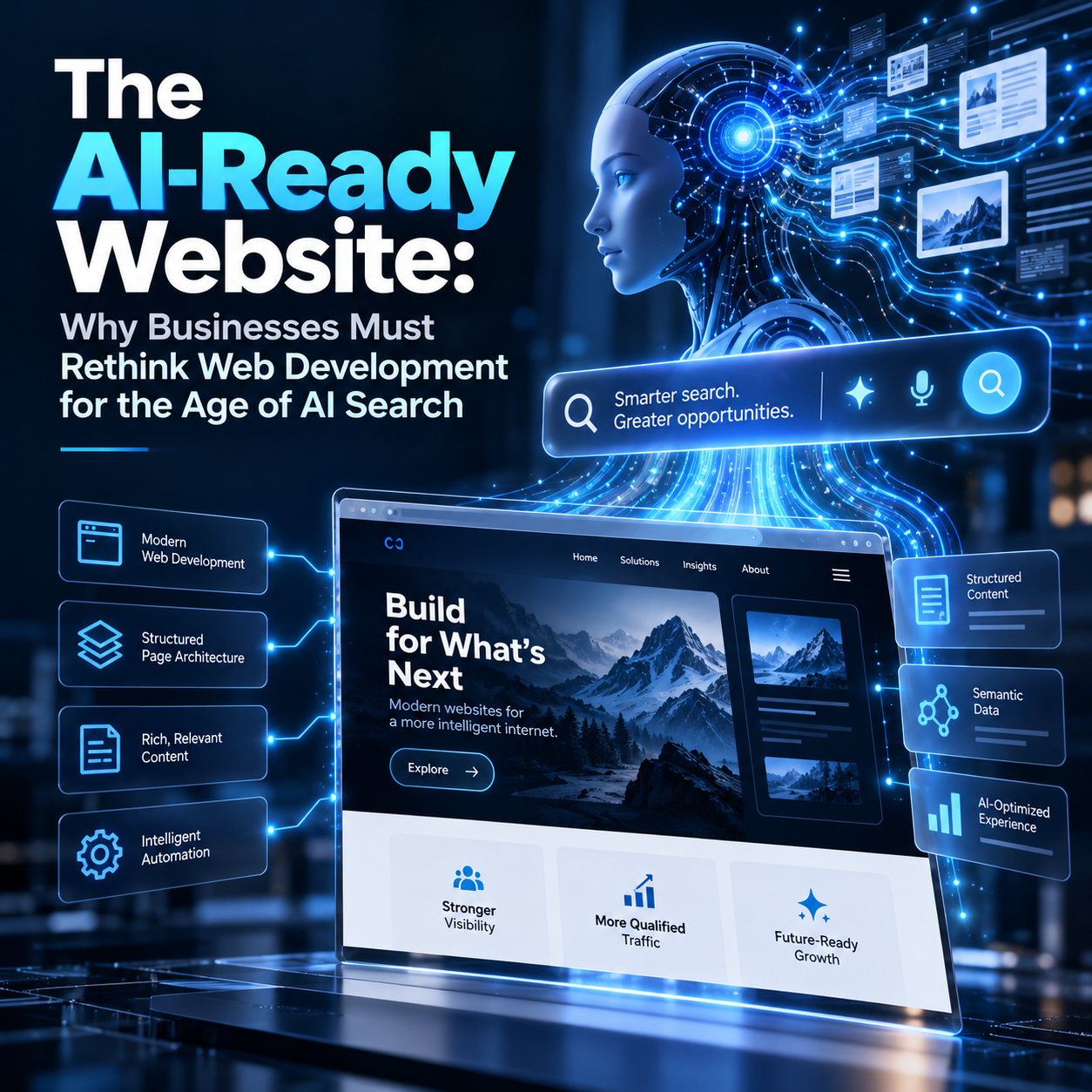



Today, potential customers aren’t exclusively typing keywords into Google and scrolling through ten blue links. They’re asking conversational questions through platforms like ChatGPT, Google’s AI-powered search experiences, Perplexity, and other artificial intelligence tools.

For years, businesses have approached website development with a relatively straightforward objective: build a visually appealing website, optimize it for Google, drive traffic, and convert visitors into customers.
That formula still matters.
But the way people discover businesses, evaluate solutions, and make purchasing decisions is changing dramatically.
Today, potential customers aren’t exclusively typing keywords into Google and scrolling through ten blue links. They’re asking conversational questions through platforms like ChatGPT, Google’s AI-powered search experiences, Perplexity, and other artificial intelligence tools.
Instead of searching for “web development company St. Louis,” someone might ask:
“What’s the best way to redesign my small business website to generate more qualified leads in St. Louis?”
Or perhaps:
“Which digital marketing agencies in St. Louis specialize in website development, SEO, and AI integration?”
The difference is significant.
Traditional search engines primarily organize and rank information. AI-powered search systems can interpret questions, synthesize information from multiple sources, and provide direct answers or recommendations.
And here’s the challenge for businesses.
If your website isn’t structured, accessible, credible, and understandable to AI-powered discovery systems, you could be missing opportunities to reach potential customers.
Having a website is no longer enough.
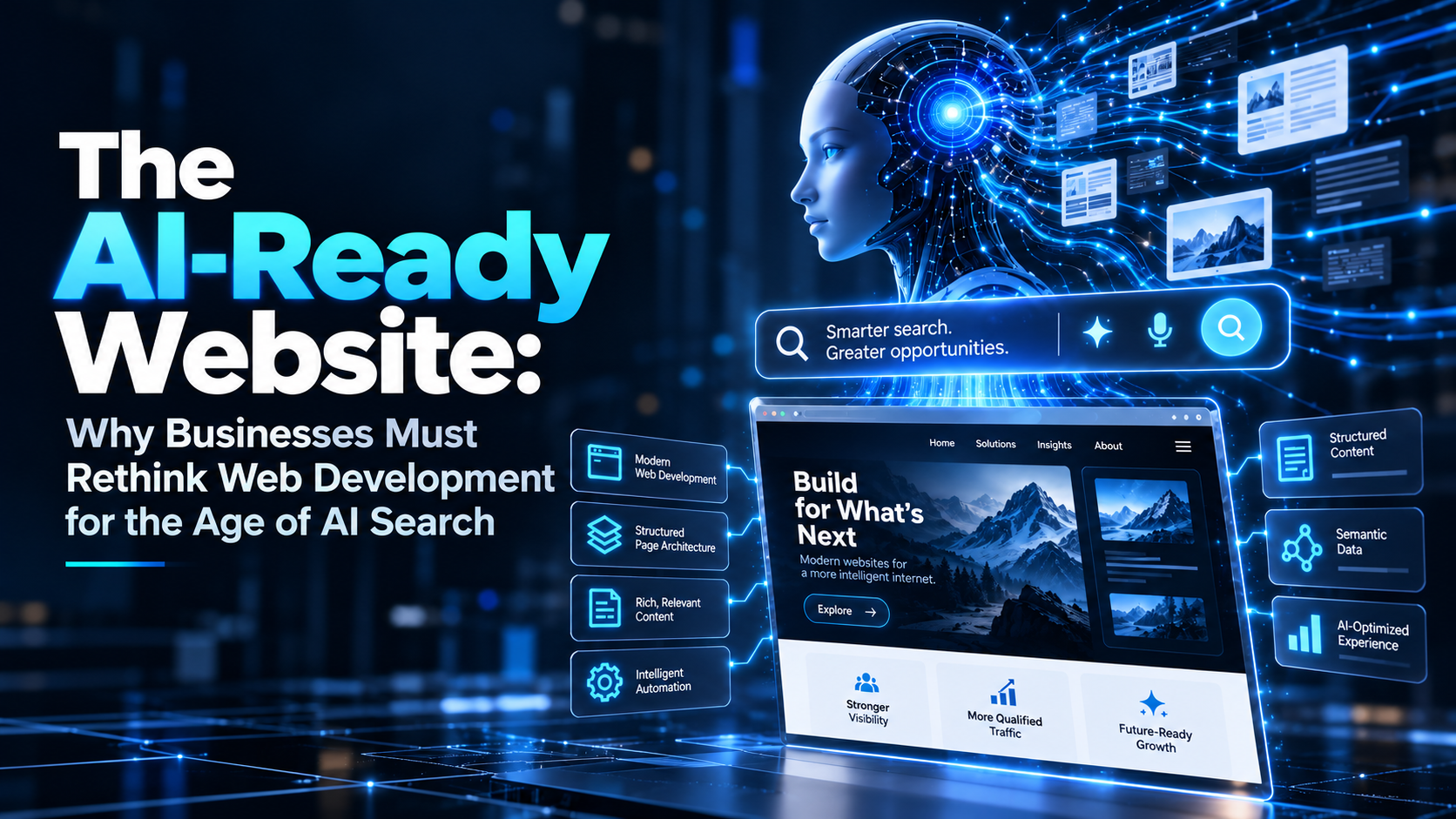
Businesses need to start thinking about building an AI-ready website — one designed not only for human visitors and traditional search engines but also for the evolving world of artificial intelligence.
At Razor Sharp Digital, we believe the future of website development isn’t about choosing between humans and AI.
It’s about creating digital experiences that serve both.
An AI-ready website is a website developed with the technical infrastructure, content organization, accessibility, and credibility signals that help search engines and AI-powered systems discover, interpret, and accurately represent its information.
But let’s clarify something important.
An AI-ready website isn’t simply a traditional website with a chatbot installed.
And it certainly isn’t a website filled with AI-generated content.
It’s a website strategically developed to communicate clearly with both humans and machines.
An AI-ready website typically includes:
Clean, semantic HTML and well-organized page architecture.
Search-engine-accessible content and crawlable navigation.
Structured data that describes the business, services, and content.
High-quality, original, human-centric information.
Fast loading speeds and responsive design.
Clear signals of business identity, expertise, and credibility.
Conversion-focused experiences that turn discovery into action.
Think of it this way.
Your website has always needed to communicate effectively with visitors.
Now, it also needs to make its information understandable to the systems those visitors use to discover and evaluate businesses.
The goal isn’t to develop a website for algorithms instead of people. It’s to develop a website that algorithms can understand and people actually want to use.
Traditional search engine optimization has largely focused on helping individual web pages appear in search results for relevant queries.
Businesses compete for visibility through content relevance, backlinks, technical optimization, local search signals, and numerous other factors.
AI search introduces another dimension.
When someone asks an AI assistant a question, the system may generate a response using its existing knowledge, retrieved web information, or a combination of both.
Depending on the platform and query, that response may reference websites, cite sources, or recommend specific businesses.
This creates a new consideration for website development.
Your website must be more than discoverable.
Its content must also be understandable, trustworthy, and useful enough to contribute to relevant answers.
Consider the evolution of a typical search.
TRADITIONAL SEARCH
“St. Louis website development company”
AI-POWERED SEARCH
“I own a small business in St. Louis. How can I redesign my website to improve lead generation, integrate AI tools, and reduce manual work?”
The second query contains substantially more context.
It reveals the customer’s location, business type, challenges, and desired outcomes.
A website with detailed, well-organized service information and genuinely helpful content is better positioned to address these kinds of questions than one relying on generic marketing statements.
That doesn’t mean keywords are obsolete.
It means search intent, contextual relevance, and content clarity are becoming even more important.
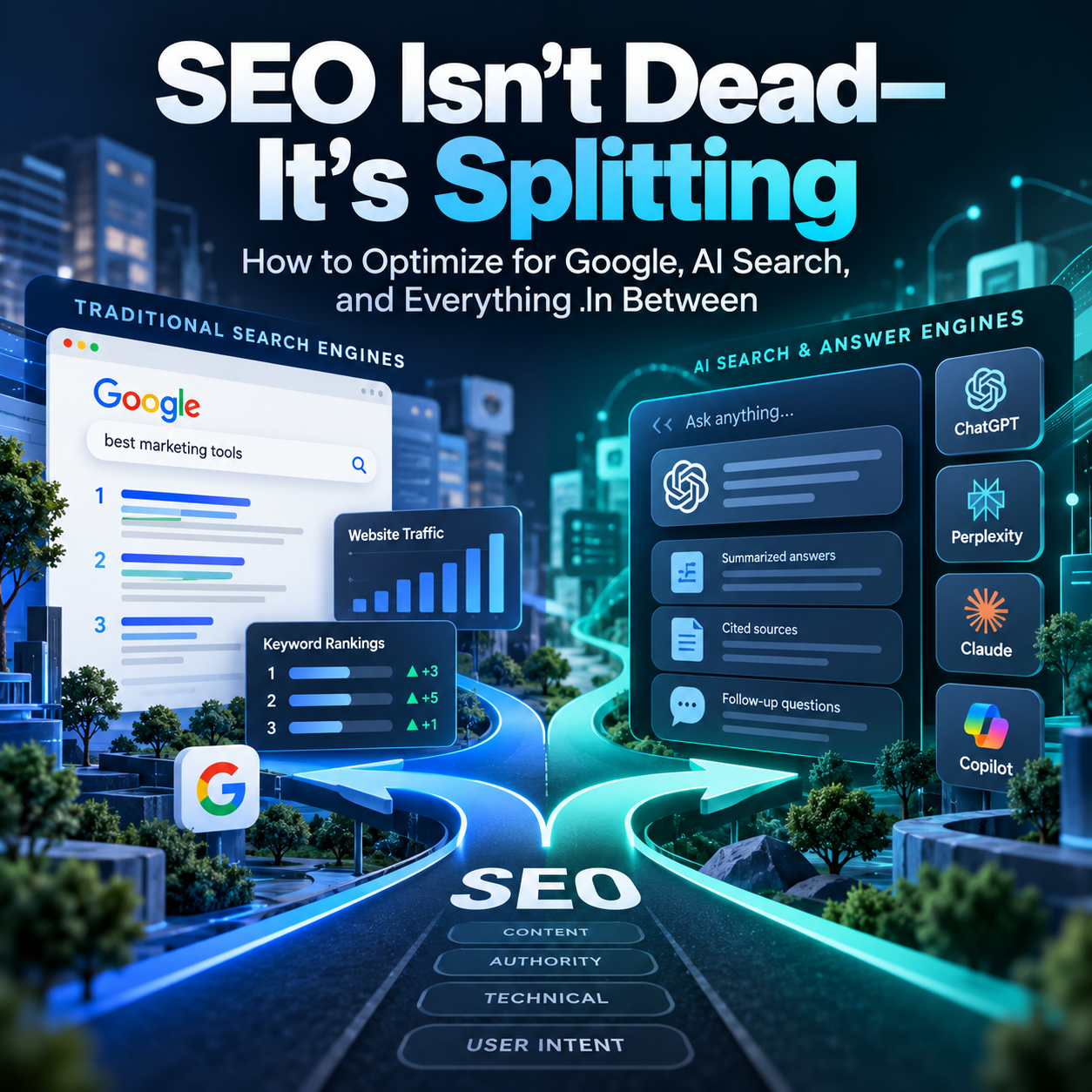
One of the biggest misconceptions surrounding AI search is that traditional SEO is dead.
It isn’t.
In fact, many of the technical foundations that support traditional search visibility also support AI-driven discovery.
Search engines and AI search tools still need ways to locate, retrieve, and interpret web content.
That’s why businesses cannot afford to neglect the fundamentals.
On-page optimization: Your website needs descriptive page titles, relevant headings, clear content hierarchy, contextual internal links, and information aligned with customer intent.
Off-page optimization: Relevant backlinks, third-party mentions, business citations, and a credible online reputation help establish authority and visibility beyond your own domain.
Indexation: Important pages must be discoverable and eligible for inclusion in search indexes. XML sitemaps, canonical URLs, appropriate robots directives, and proper site architecture all contribute to this process.
Accessibility: Content should be available through semantic HTML, understandable navigation, accessible interfaces, and compatible rendering across devices and assistive technologies.
These foundations remain essential regardless of how sophisticated AI search becomes.
However, technical SEO alone isn’t a guarantee that an AI system will cite or recommend your business.
Different AI platforms retrieve and evaluate information differently.
The strategic opportunity is to combine established SEO practices with content clarity, entity information, and a strong digital reputation.
One of the most valuable technical considerations for an AI-ready website is structured data.
Structured data is standardized information added to a website to help compatible systems identify what specific content represents.
For example, a St. Louis digital marketing agency might use structured data to describe its:
Business name and official website.
Physical location and service area.
Contact information.
Services and organizational identity.
Articles, authors, and relevant business information.
Schema.org provides a widely used vocabulary for describing this information.
JSON-LD is a common format for implementing it.
For businesses, relevant schema types may include Organization, LocalBusiness, Service, BreadcrumbList, and Article, depending on the page.
Imagine two websites offering the same service.
One contains generic paragraphs about website development.
The other clearly identifies the business, its services, location, authorship, and relationships between relevant pages.
The second website gives compatible search systems additional machine-readable context.
That can help reduce ambiguity about what the business does and how its content is organized.
However, structured data isn’t a magic shortcut to AI search rankings.
Adding schema markup does not guarantee placement in Google AI Overviews, citations in ChatGPT, or recommendations from other AI platforms.
It is one component of a larger strategy.
Structured data helps describe your business. Your content, technical performance, and reputation must support those descriptions.
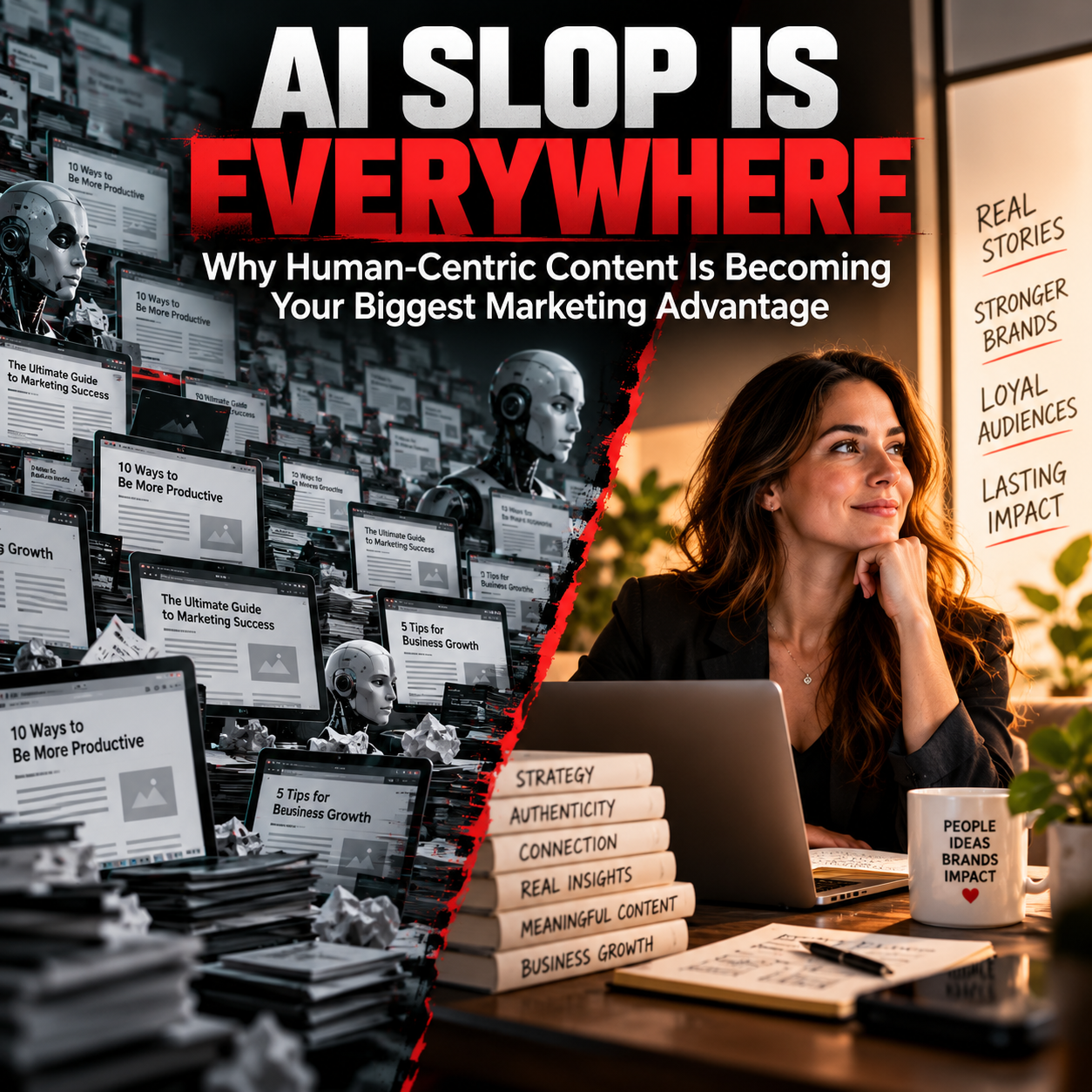
Artificial intelligence has made content production easier than ever.
Businesses can generate hundreds of blog posts, landing pages, and social media captions in a fraction of the time previously required.
But easier production doesn’t automatically mean better content.
In fact, the widespread availability of AI-generated material creates a new challenge.
The internet is becoming increasingly crowded with repetitive, generic, and sometimes inaccurate information.
That makes original human insight especially valuable.
Consider two website development companies.
Company A publishes a generic article titled “Five Benefits of Having a Website.”
Company B publishes a detailed breakdown of how it improved a client’s website navigation, corrected technical SEO problems, streamlined lead capture, and improved the visitor experience.
Which article provides more distinctive value?
The second.
It demonstrates practical experience, a real problem-solving process, and specific business context.
That kind of content can be valuable to readers and potentially useful to AI-powered discovery systems.
For businesses in St. Louis, human-centric content might include local case studies, customer questions, industry-specific insights, original research, and lessons learned from actual projects.
AI can absolutely assist with research, outlining, editing, and content production.
But businesses should preserve the expertise and authenticity that make their perspectives unique.
In an AI-saturated digital environment, human experience isn’t becoming irrelevant. It’s becoming a differentiator.
A visually impressive website isn’t necessarily a technically effective website.
Modern web development often includes animations, interactive components, JavaScript frameworks, and complex visual experiences.
Those features can improve usability when implemented thoughtfully.
But poorly implemented architecture can make content difficult for crawlers, assistive technologies, and certain AI retrieval systems to access.
Semantic HTML communicates the purpose and structure of website elements.
For example:
An <h1> element identifies a primary page heading.
<nav> identifies a navigation region.
<main> identifies primary page content.
<article> identifies self-contained content.
Descriptive links explain where users will go.
These elements help establish meaningful structure.
They also support accessibility and maintainability.
Some websites rely heavily on client-side JavaScript to generate content.
While major search engines can render many JavaScript-driven pages, not every crawler or retrieval system has the same capabilities.
Critical website content should therefore be accessible without unnecessary technical barriers.
Server-side rendering, static generation, or other appropriate rendering strategies may improve content availability.
The objective isn’t to abandon modern frameworks.
It’s to make deliberate technical choices based on discoverability, performance, and usability.
AI search visibility might help customers discover your business.
But what happens when they arrive on your website?
That’s where traditional website development principles remain essential.
A slow, confusing, or poorly designed website can undermine the value of your marketing efforts.
Customers still expect websites to load quickly, work on mobile devices, communicate clearly, and make the next step obvious.
Google’s Core Web Vitals provide useful measurements of real-world user experience.
They include:
Largest Contentful Paint (LCP): Measures how quickly the main visible content loads.
Interaction to Next Paint (INP): Measures responsiveness to user interactions.
Cumulative Layout Shift (CLS): Measures unexpected visual movement.
Improving these metrics can create a smoother experience for visitors.
But performance optimization shouldn’t stop with technical scores.
Businesses should also evaluate navigation, readability, accessibility, mobile usability, and conversion opportunities.
A website that attracts traffic but fails to generate meaningful engagement isn’t fulfilling its business purpose.
AI search may influence how customers find you. User experience influences what happens after they do.
Your website doesn’t exist in isolation.
AI-powered discovery can involve information from multiple sources, including business directories, customer reviews, articles, third-party websites, and public business profiles.
That means businesses should consider their entire digital footprint.
For St. Louis businesses, this includes maintaining accurate information across Google Business Profile, relevant directories, social media profiles, and industry-specific platforms.
Your business name, services, location, and contact information should remain consistent wherever customers encounter your brand.
This doesn’t mean every online mention directly improves AI search visibility.
Instead, a consistent and credible digital presence makes it easier for customers and information systems to understand who you are and what you offer.
A St. Louis website development company that publishes relevant local insights can demonstrate a level of market understanding that generic national content may lack.
For example, articles addressing website development challenges for St. Louis contractors, manufacturers, professional service providers, and small businesses can connect technical expertise with specific customer needs.
The objective isn’t to repeat “St. Louis web development” throughout every paragraph.
It’s to demonstrate genuine relevance to the businesses and communities you serve.
Here’s something businesses often overlook when discussing AI search.
Visibility doesn’t automatically equal revenue.
Even if your website appears prominently in traditional search results or receives referrals from AI-powered platforms, that visibility only creates an opportunity.
Your website must still convert interest into meaningful business outcomes.
An AI-ready website should therefore be developed with conversion rate optimization (CRO) in mind.
That includes clear calls to action, persuasive service descriptions, relevant social proof, and intuitive contact experiences.
It also means eliminating unnecessary friction.
If someone discovers your business through an AI-generated recommendation, they should immediately understand what you do, whom you serve, and how to take the next step.
Beyond search visibility, artificial intelligence can also enhance website functionality.
Depending on business needs, AI-powered capabilities might include conversational assistants, automated lead qualification, appointment scheduling, CRM integrations, and personalized content recommendations.
However, these tools should solve actual business problems.
Installing an AI chatbot simply because artificial intelligence is trending isn’t a strategy.
Implementing an intelligent lead qualification process that reduces response times and helps your sales team prioritize opportunities is a strategy.
The difference is business purpose.
Your website should function as an extension of your marketing, sales, and customer service operations — not simply as a digital business card.
Businesses don’t necessarily need to rebuild their entire websites to become better prepared for AI-driven discovery.
In many cases, the smartest starting point is a comprehensive website audit.
Use this practical checklist to identify opportunities for improvement.
IMPLEMENTATION PROGRESS
An effective audit should evaluate both technical conditions and business performance.
It should identify which pages are attracting visitors, which content addresses high-intent questions, where users abandon the conversion process, and whether important services are clearly represented.
Businesses should also begin monitoring their visibility across relevant AI search experiences.
Google’s 2026 guidance emphasizes that established SEO practices remain the foundation for visibility in its generative search features, rather than requiring special AI-only markup or content formatting.
The objective should be measurable improvement, not chasing every new AI optimization trend.
As artificial intelligence continues evolving, websites will need to support increasingly sophisticated forms of digital interaction.
AI assistants may help customers research services, compare providers, evaluate products, and complete certain online tasks.
This creates opportunities for businesses that invest in accessible information, dependable functionality, and well-organized digital experiences.
But technology alone won’t determine success.
Businesses will still need to earn trust.
They’ll still need to communicate value.
And they’ll still need to provide products, services, and customer experiences worth recommending.
That’s why human-centric website development remains so important.
AI should help remove friction, improve accessibility, and create operational efficiency.
It shouldn’t eliminate the personality, judgment, and authenticity that differentiate one business from another.
The strongest websites will combine technical sophistication with meaningful human experiences.
The way people discover businesses is changing.
AI-powered search is creating new opportunities for customers to find answers, evaluate providers, and make decisions without following the traditional search journey.
For businesses, that means website development must evolve beyond aesthetics and basic functionality.
An AI-ready website should be technically accessible, clearly structured, supported by credible content, and optimized for meaningful customer engagement.
It should help search engines understand your business, help AI systems accurately interpret available information, and help real people make confident decisions.
Most importantly, it should contribute to measurable business growth.
The future of web development isn’t about building websites exclusively for AI.
It’s about building smarter, more accessible, human-centric websites that are prepared for how people search, interact, and do business next.
At Razor Sharp Digital, we help businesses rethink their digital presence through strategic website development, search engine optimization, digital marketing, and technology-driven solutions.
Whether you’re planning a website redesign, improving your SEO strategy, or exploring ways to integrate AI into your business operations, the right foundation matters.
Don’t wait until your website becomes a barrier to growth.
Learn about strategic human marketing and how it can benefit your business.
Download for FREE TODAY!
Get all the latest content, news, and digital marketing insights to help you humanize your brand.
Join thousands getting our insider updates learning how to grow their business using AI + human centricity.
(P.S. We will NEVER sell your personal data to anyone like the other guys do)
Your company needs humanization and personalization in order for it to thrive and grow. Our systematic, strategic, and seasoned approach will help you thrive and grow. Let’s discuss ways we can help your business become more human-centric so you can dominate.
The main entrance to our primary domain.
The 10 commandments that we live by, practice by, and service our customers. The Holy Grail of our entire philosophy if you’d like to call it that.
The digital and social media vault where we share our insights, experiences, and advice on how to humanize your brand so you can thrive and grow.
A full breakdown of all of our service offerings in the digital and social media spectrum.
How it all started, our story, and who is behind this human marketing agency.
Are you a natural-born superstar? Looking to make a global impact? We are always seeking aspiring rockstars to join our team.
The best way to get in touch with us about your digital and social media needs.