Every few years, someone declares that SEO is dead.
Social media was supposed to kill it. Voice search was supposed to kill it. Zero-click searches were supposed to kill it. And now artificial intelligence is supposedly delivering the final blow.
Except SEO isn’t dead.
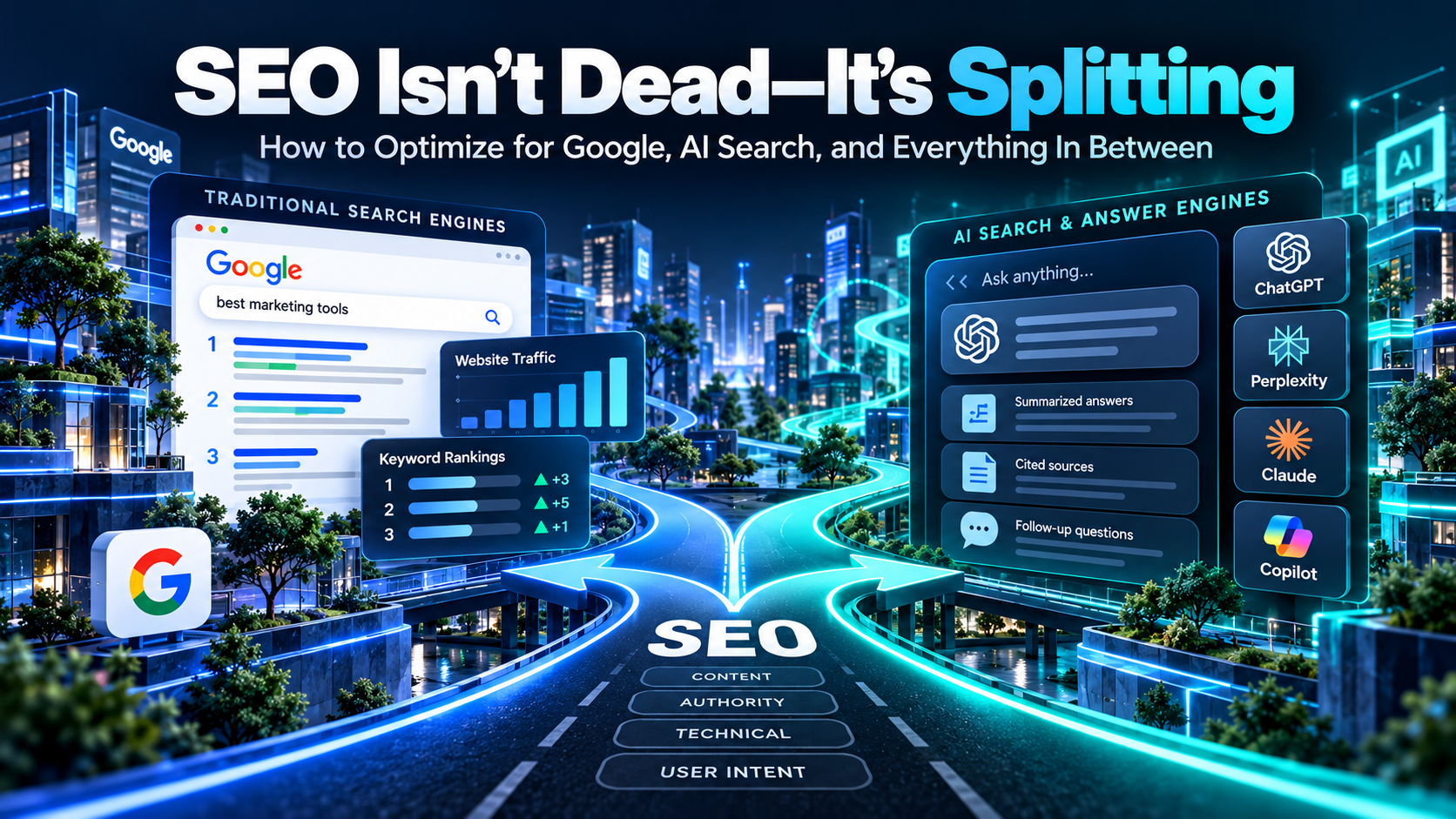
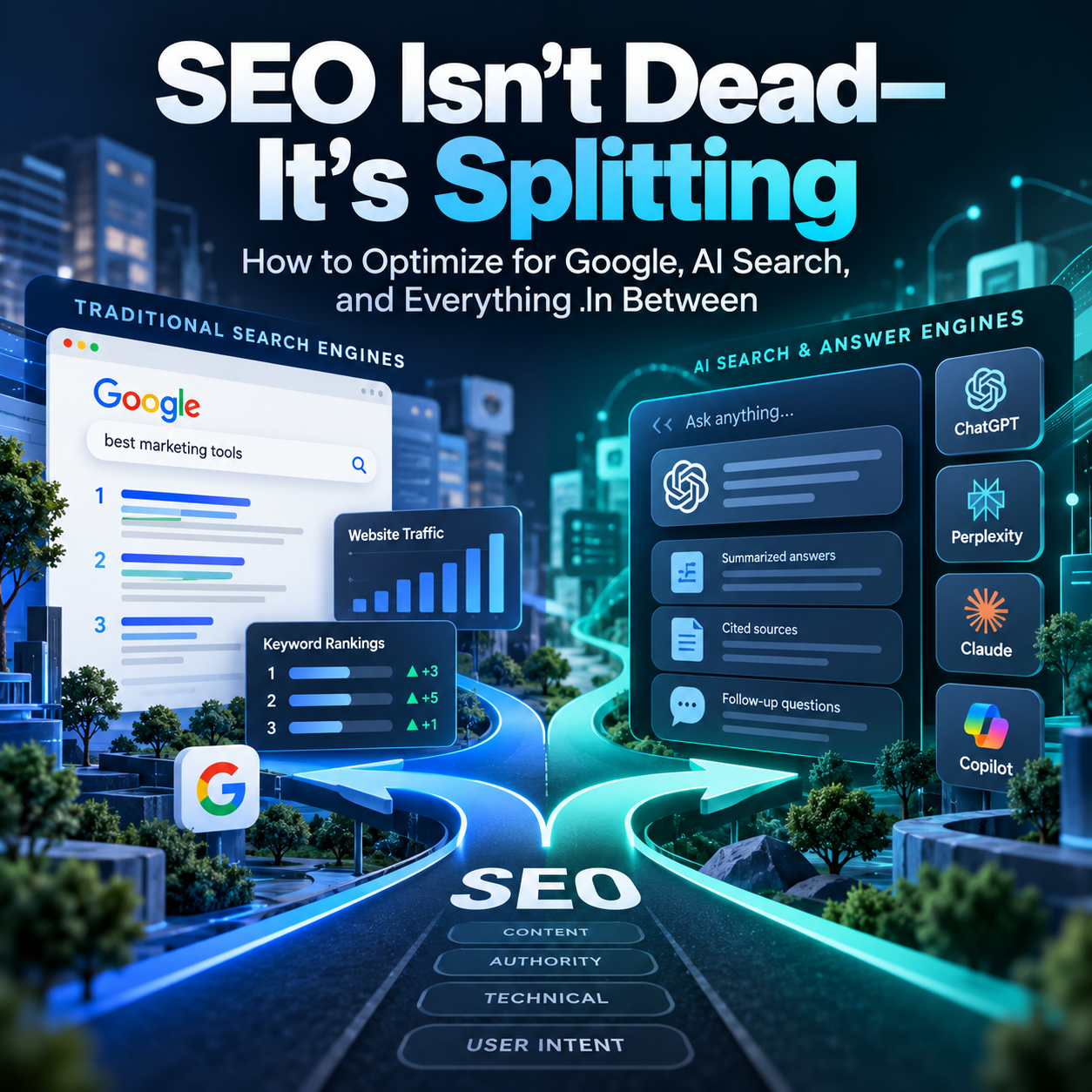
SEO is splitting.
For years, search engine optimization primarily meant optimizing your website to appear prominently on Google and other traditional search engines. You researched keywords, optimized pages, earned backlinks, improved technical performance, and fought for a spot on page one.
Those fundamentals still matter.
But the environment surrounding them has changed dramatically.
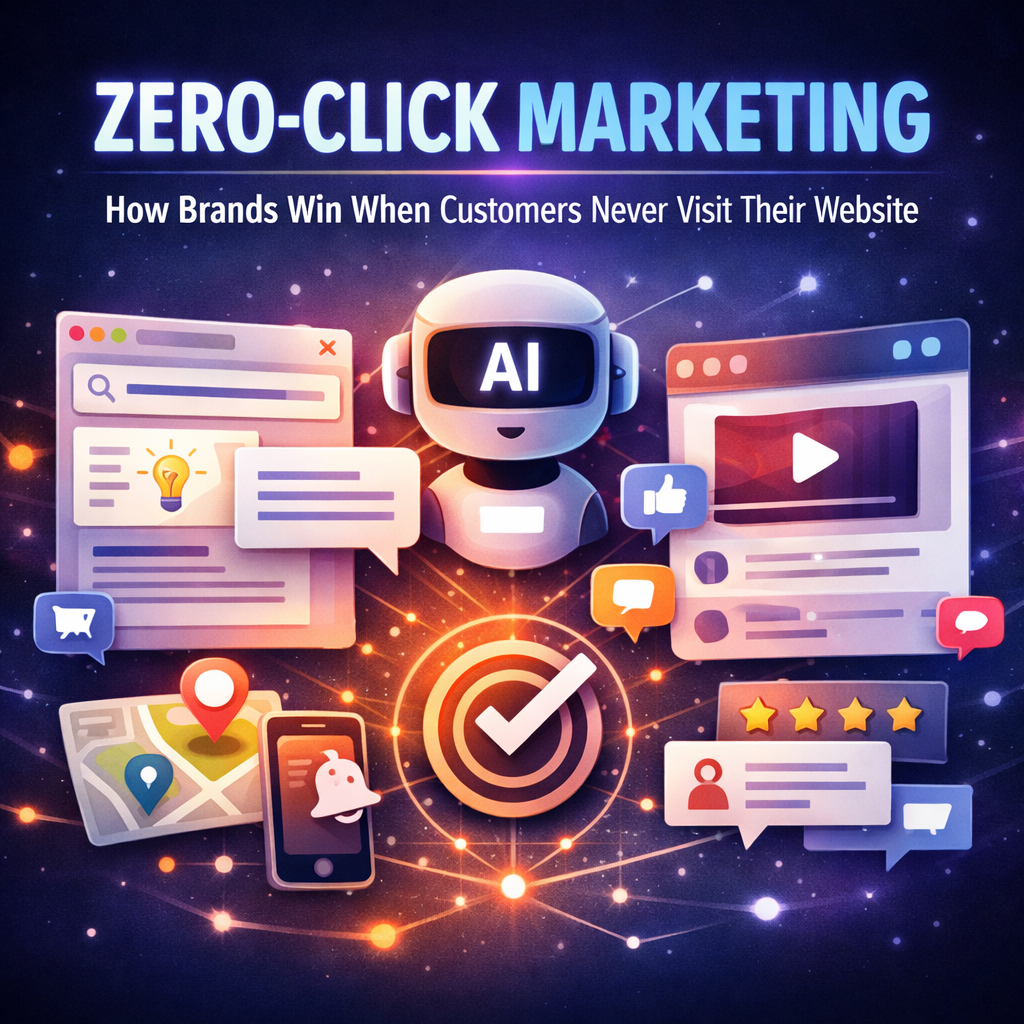
People can now discover businesses and information through Google Search, AI Overviews, AI Mode, Microsoft Copilot, ChatGPT and other AI assistants, social platforms, maps, video results, image searches, review platforms, and a growing collection of AI-powered discovery experiences.
Search has become fragmented.
For businesses in St. Louis and beyond, the challenge is no longer simply:
“How do we rank higher on Google?”
The better question is:
“How do we make our business discoverable wherever our customers are searching, asking questions, researching, and making decisions?”
That is what modern SEO is becoming.
Traditional SEO Still Matters
Before abandoning everything you know about SEO and chasing the newest acronym, understand something important:
Traditional SEO remains the foundation.
Google still needs to discover, crawl, understand, and index web pages. Search engines still evaluate relevance, usefulness, authority, site architecture, internal linking, technical accessibility, and numerous other signals.
Google also continues to use structured data to better understand information contained on webpages and potentially present that information through enhanced search experiences.
The fundamentals haven’t disappeared.
They have become the infrastructure supporting a much larger discovery ecosystem.
A strong SEO strategy still includes:
-
Technical SEO and crawlability
-
Website accessibility
-
On-page optimization
-
Search intent alignment
-
Internal linking
-
Relevant backlinks
-
Local SEO
-
Google Business Profile optimization
-
Helpful and original content
-
Structured data
-
Fast, mobile-friendly experiences
-
Clear website architecture
-
Accurate business information
Think of traditional SEO as the foundation of a house.
AI search doesn’t eliminate the foundation.
It builds another floor on top of it.
Google Search Is Becoming an Answer Engine
Google itself is no longer simply a directory of websites.
Search results increasingly combine traditional organic listings with maps, videos, images, featured answers, shopping results, AI-generated experiences, and other search features.
That means ranking #1 organically is no longer necessarily the only—or even always the most valuable—measure of search visibility.
A user searching for:
“best digital marketing agency in St. Louis for small businesses”
might encounter local results, organic listings, reviews, AI-generated recommendations, videos, company information, or other sources during their research.
The search journey is becoming less linear.
Businesses therefore need to stop thinking exclusively about rankings and start thinking about search presence.
Ask:
Where does our brand appear?
What does Google understand about us?
What information exists about us across the web?
Do authoritative websites mention us?
Does our website clearly explain our expertise?
Are our services, location, people, and expertise easy for search systems to understand?
Those questions increasingly matter alongside traditional keyword rankings.
AI Search Changes the Definition of Visibility
Traditional search optimization focuses heavily on earning a position.
AI search introduces another objective:
earning a citation, reference, recommendation, or inclusion within an answer.
That distinction is significant.
Microsoft’s Bing Webmaster Tools now includes AI Performance reporting showing publishers how their pages are cited within AI-generated answers across supported Microsoft experiences. The reporting includes citation activity and information about queries used to retrieve cited content.
Bing has subsequently expanded those capabilities to include insights such as topics, intents, citation share, and comparisons.
That’s an important glimpse into where search measurement is heading.
Instead of asking only:
“What position are we ranking?”
marketers increasingly need to ask:
“Are AI systems using our website as a source?”
This is one reason concepts such as Generative Engine Optimization (GEO) and Answer Engine Optimization (AEO) have become increasingly important.
The terminology may continue evolving, but the underlying principle is straightforward:
Your content needs to be easy for both humans and machines to discover, understand, trust, retrieve, and reference.
SEO, AEO, and GEO: What’s the Difference?
You may encounter several different terms describing modern search optimization.
SEO — Search Engine Optimization
SEO focuses on increasing organic visibility within search engines such as Google and Bing.
AEO — Answer Engine Optimization
AEO focuses on structuring information so search and answer systems can easily understand and surface direct answers to questions.
GEO — Generative Engine Optimization
GEO generally describes optimizing your digital presence so generative AI systems can understand, retrieve, reference, and potentially cite your information when constructing responses.
Microsoft itself has described GEO in relation to how content participates in AI-driven experiences, where visibility extends beyond rankings into citations, answers, and outcomes.
These disciplines shouldn’t be treated as completely separate marketing strategies.
They overlap.
Strong technical SEO makes content discoverable.
Strong content makes information useful.
Authority helps establish credibility.
Clear structure makes information easier to understand.
Original expertise gives other websites—and potentially AI systems—a reason to reference you.
Modern optimization combines all of them.
Stop Writing for Keywords. Start Building Topical Authority.
Keywords still matter.
Keyword stuffing doesn’t.
The days of writing ten nearly identical pages targeting slightly different variations of a phrase should be firmly behind us.
Instead, businesses should develop topic ecosystems.
Suppose a St. Louis digital marketing agency wants greater visibility around social media marketing.
One service page isn’t enough to demonstrate substantial expertise.
A stronger ecosystem might contain content about:
-
Social media strategy for small businesses
-
Facebook marketing
-
Instagram marketing
-
LinkedIn marketing
-
Short-form video strategy
-
Social media content calendars
-
Organic vs. paid social media
-
Social media analytics
-
Lead generation through social media
-
Common social media marketing mistakes
-
Industry-specific social strategies
-
St. Louis social media marketing trends
These resources can internally link to one another and ultimately support a primary service page.
Instead of publishing disconnected articles chasing individual keywords, you’re creating an interconnected body of knowledge.
That helps users understand your expertise and gives search systems greater context around what your organization actually knows.
Write Content That Can Be Quoted and Cited
AI search creates an interesting new content requirement.
Your information should be extractable.
That doesn’t mean writing robotic content for AI.
It means communicating clearly.
If someone asks:
“How much should a small business spend on SEO?”
don’t bury your answer beneath 700 words of generic introduction.
Answer the question.
Then explain the variables.
Use clear headings, concise definitions, supporting statistics, examples, tables where appropriate, and logical sections.
Microsoft specifically recommends strengthening expertise, improving content structure and clarity, supporting claims with evidence, maintaining accurate information, and reducing ambiguity when improving content for AI-generated answers.
A useful format is:
Question → Direct Answer → Explanation → Evidence → Example → Next Step
This works for humans because it respects their time.
It also produces clearly structured information that search and AI systems can interpret.
Original Experience Is Becoming More Valuable
There is an enormous amount of generic AI-generated content flooding the internet.
Publishing another article titled 10 Benefits of Digital Marketing containing information that exists on thousands of other websites probably isn’t going to differentiate your business.
Your advantage is information other organizations cannot easily replicate.
That includes:
Firsthand experience.
What have you actually seen working?
Original data.
What can you learn from your customers, campaigns, analytics, or internal research?
Case studies.
What problem existed, what did you do, and what happened?
Expert opinions.
What do you believe people in your industry are getting wrong?
Proprietary processes.
How does your organization solve problems differently?
Local expertise.
What have you learned specifically from working with businesses in the St. Louis market?
Consider the difference between these two articles:
“5 Tips for Better Social Media Marketing”
versus:
“What We Learned Generating 3 Million+ Organic Video Views for Brands”
The second has something the first doesn’t:
experience.
AI can summarize existing knowledge extremely well.
Your competitive advantage is producing knowledge worth summarizing.
Local SEO Is Also Becoming AI SEO
For local businesses, local SEO remains extremely important.
But local optimization now extends beyond appearing in the traditional map pack.
AI-powered systems also need accurate information about:
That means St. Louis businesses should maintain consistent information across their website, Google Business Profile, Bing Places, directories, social profiles, review platforms, industry websites, news publications, and other authoritative sources.
Microsoft specifically recommends accurate local business information and Bing Places for Business as part of improving eligibility within location-based AI experiences.
For a St. Louis business, that means local optimization shouldn’t simply consist of inserting “St. Louis” into every paragraph.
Build genuine local relevance.
Publish St. Louis-specific resources.
Earn mentions from local organizations.
Generate legitimate customer reviews.
Participate in the community.
Build partnerships.
Earn local media coverage.
Create location-specific case studies.
Demonstrate that you’re actually part of the St. Louis business ecosystem.
Local authority is much harder to fake than a keyword.
Your Brand Is Becoming an SEO Asset
Modern search optimization is increasingly connected to brand building.
Search engines and AI systems encounter information about companies across numerous websites and platforms.
Your website is one source.
Reviews are another.
Social profiles are another.
News articles, podcasts, directories, YouTube videos, industry websites, business associations, and third-party mentions add additional context.
That makes digital PR, content marketing, social media, SEO, and brand strategy increasingly interconnected.
The goal isn’t simply acquiring backlinks.
The bigger goal is building a recognizable entity around your business.
You want search systems—and potential customers—to repeatedly encounter consistent signals connecting:
Your Brand → Your Services → Your Expertise → Your Location → Your Reputation
For a St. Louis marketing company, for example, that might mean establishing associations around:
Brand → Digital Marketing → SEO → Social Media → Web Development → Paid Media → St. Louis
This doesn’t happen through one optimized webpage.
It happens through sustained digital presence.
Don’t Ignore Technical SEO
The excitement around AI search has caused some marketers to overlook something obvious.
AI systems cannot effectively retrieve content they cannot access or understand.
Technical SEO therefore remains essential.
Maintain:
-
Clean crawl paths
-
XML sitemaps
-
Accurate canonical tags
-
Proper redirects
-
Logical internal linking
-
Mobile usability
-
Fast page performance
-
HTTPS
-
Structured data where appropriate
-
Proper indexation controls
-
Accessible content
-
Descriptive page titles
-
Strong heading structures
Sitemaps remain particularly important for helping search systems discover and understand current website content. Microsoft continues to recommend XML sitemaps alongside technologies such as IndexNow for improving discovery of updated pages across traditional and AI-powered search experiences.
Technical SEO isn’t glamorous.
But neither Google nor an AI search engine can recommend content it doesn’t know exists.
Search Is Becoming Multimodal
Another major shift is occurring beyond text.
People increasingly search using:
-
Images
-
Video
-
Voice
-
Screenshots
-
Cameras
-
Conversational prompts
-
Traditional text queries
Google’s Search Console expanded reporting in 2026 to provide website owners with visibility into multimodal searches involving experiences such as Lens, Circle to Search, uploaded images, and visual search functionality.
That means businesses need to broaden what they consider “searchable content.”
Images should have context.
Videos should have descriptive titles and supporting copy.
YouTube content should reinforce relevant expertise.
Original photography can strengthen local and brand signals.
Video transcripts can create additional crawlable information.
Your SEO strategy shouldn’t end with written blog articles.
Search visibility increasingly exists across formats.
The New SEO Measurement Framework
Traditional SEO reporting often revolves around:
Rankings.
Traffic.
Clicks.
Impressions.
Conversions.
Those metrics still matter.
But modern search requires additional measurements.
Businesses should increasingly monitor:
Organic visibility — Are we appearing across relevant search experiences?
Branded search demand — Are more people actively searching for us?
AI citations — Are AI platforms referencing our content?
Referral traffic from AI platforms — Are AI-driven experiences sending qualified visitors?
Entity visibility — Does our brand consistently appear around relevant topics?
Local visibility — Are we prominent for geographically relevant searches?
Conversions — Does visibility ultimately generate leads, sales, calls, or other business outcomes?
Microsoft’s introduction of citation-based AI performance reporting is an early indication that the analytics surrounding search are evolving alongside search itself.
SEO reporting needs to evolve too.
What Should St. Louis Businesses Do Right Now?
Don’t throw away your existing SEO strategy.
Expand it.
Continue optimizing your website for Google.
Continue improving technical performance.
Continue earning legitimate backlinks.
Continue creating valuable content.
Continue strengthening your Google Business Profile and local presence.
But add another layer.
Create content that directly answers customer questions.
Publish firsthand insights.
Develop topic clusters around your expertise.
Strengthen your brand presence across reputable third-party platforms.
Use structured data appropriately.
Keep business information consistent.
Create video and visual content.
Build genuine local authority.
Monitor AI citations and referrals where data is available.
Most importantly, stop thinking about SEO as manipulating an algorithm.
Think about it as making your organization understandable, discoverable, credible, and useful across the entire digital ecosystem.
SEO Isn’t Dying. The Search Ecosystem Is Expanding.
The future of SEO isn’t Google versus AI.
It’s Google and AI.
It’s search engines, answer engines, social platforms, video platforms, maps, reviews, AI assistants, and whatever discovery experience comes next.
Businesses that obsess over one algorithm will constantly feel like they’re falling behind.
Businesses that build authority, useful information, technical accessibility, genuine expertise, and a recognizable brand will be much better positioned to adapt.
Because platforms will change.
Algorithms will change.
Interfaces will change.
How people ask questions will change.
But people will always need to discover businesses, evaluate options, solve problems, and determine whom they trust.
That’s the real purpose of SEO.
SEO isn’t dead.
It’s becoming bigger than search engines.
And the businesses that understand that shift now will have an enormous advantage in the next era of digital discovery.
Ready to Build Visibility Beyond Traditional Google Rankings?
At Razor Sharp Digital, we help businesses build digital strategies focused on visibility, credibility, discoverability, and sustainable growth—not simply chasing rankings.
If your St. Louis business wants to strengthen its SEO strategy while preparing for AI-powered search, now is the time to evolve.
Contact Razor Sharp Digital to start building a search strategy designed for where customers are searching today—and where search is going next.