




Businesses can brainstorm ideas faster, create first drafts in seconds, repurpose long-form content, analyze customer data, generate outlines, improve workflows, and automate repetitive marketing tasks that once consumed hours.

Artificial intelligence has made content creation faster, cheaper, and easier than ever.
That should be great news for marketers.
And in many ways, it is.
Businesses can brainstorm ideas faster, create first drafts in seconds, repurpose long-form content, analyze customer data, generate outlines, improve workflows, and automate repetitive marketing tasks that once consumed hours.
But there is a growing problem.
The internet is becoming flooded with content that technically checks all the boxes while saying almost nothing.
Generic blog posts. Predictable LinkedIn updates. Formulaic captions. AI-generated videos with no personality. Articles that repeat what twenty other websites already said. Emails that sound polished but completely forgettable.
There is now a popular term for it:
AI slop.
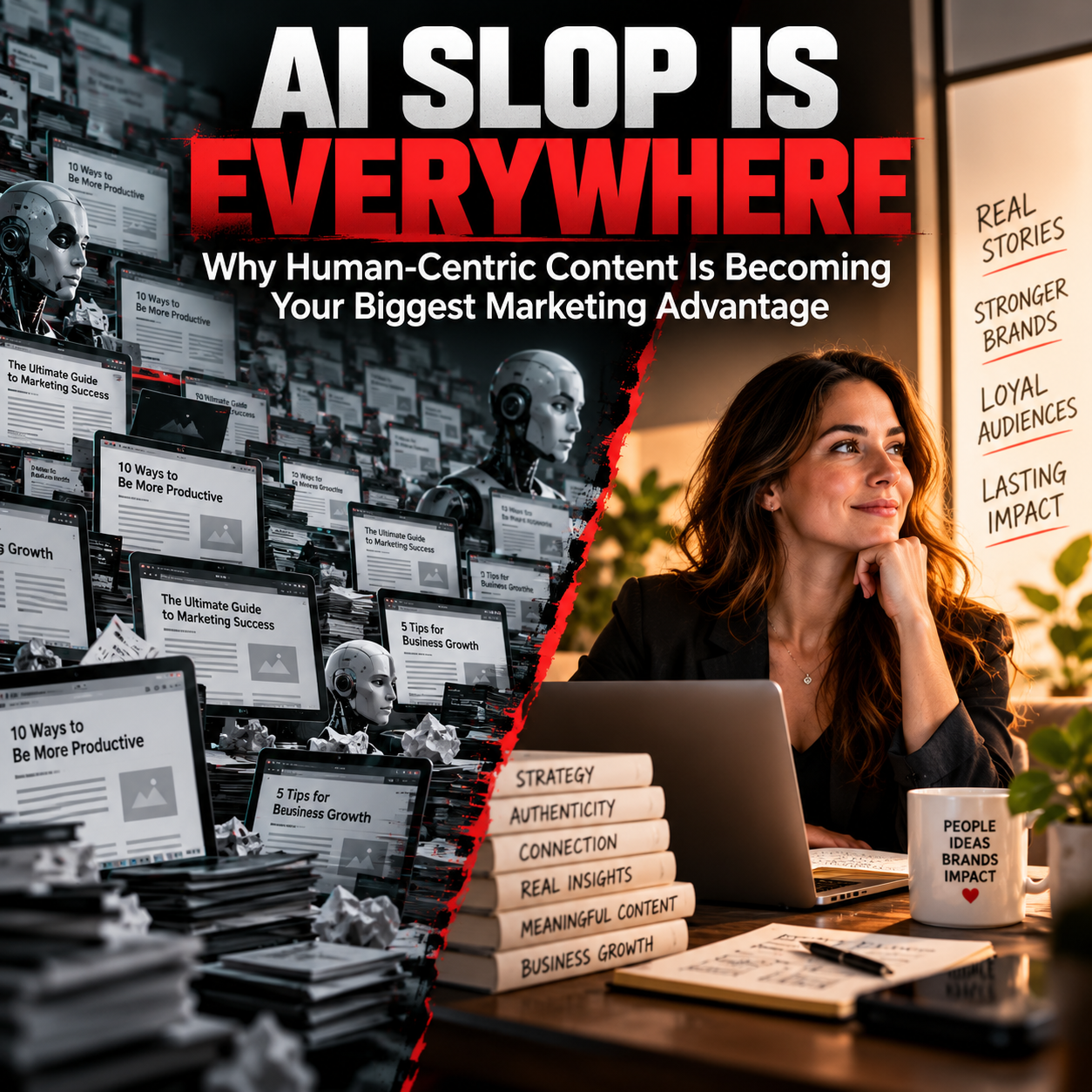
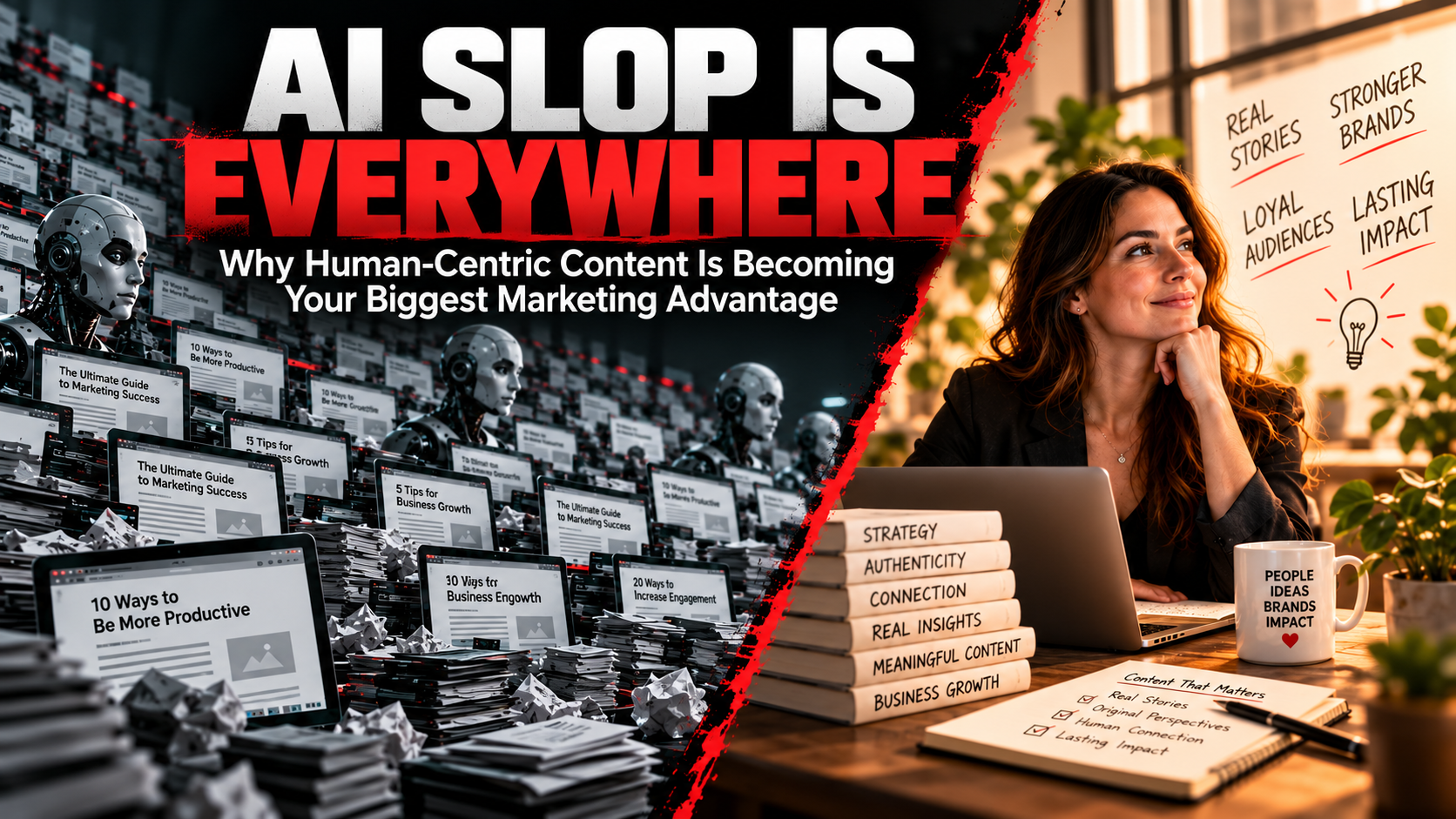
AI slop is low-value, mass-produced content created primarily because technology makes it possible to produce content at enormous scale.
The problem isn’t necessarily that artificial intelligence was involved.
The problem is that nobody added meaningful human thought afterward.
And as AI-generated content becomes more common, something interesting is happening.
Human-centric content is becoming more valuable, not less.
Businesses that combine artificial intelligence with genuine experience, personality, expertise, opinion, empathy, and creativity may have one of the biggest marketing advantages of the next several years.
For businesses competing in St. Louis and beyond, the opportunity isn’t to avoid AI.
It’s to stop using AI as a replacement for thinking.
AI slop is content generated quickly and cheaply with little meaningful originality, expertise, judgment, or human involvement.
It often looks professional at first glance.
The grammar is correct.
The headings are organized.
The sentences flow.
The graphics look polished.
But something feels missing.
That missing ingredient is usually human perspective.
AI slop tends to have several recognizable characteristics:
Generic language that could belong to almost any company
Repetitive ideas without new insight
Overused phrases and predictable formatting
Articles created primarily to target keywords
Social posts that sound suspiciously similar to everyone else’s
Information summarized from existing sources without adding expertise
Content published at high volume without clear strategic purpose
Advice with no examples, experience, case studies, or original perspective
The irony is that artificial intelligence itself isn’t necessarily the problem.
The problem is how businesses use it.
AI can help an experienced marketer produce excellent content faster.
It can also help someone with very little understanding produce hundreds of mediocre pieces of content.
The technology amplifies the operator.
That distinction matters.
For years, businesses struggled to create enough content.
Companies worried about publishing frequently enough.
Marketing teams needed more blogs.
Social media managers needed more posts.
SEO teams needed more pages.
Sales teams needed more email copy.
Video teams needed more scripts.
Artificial intelligence dramatically changed that equation.
Content production is no longer necessarily the bottleneck.
Attention is.
Your customers don’t need more content.
They need more reasons to care about yours.
When everyone can generate a 1,500-word article in minutes, the existence of the article itself creates very little competitive advantage.
The advantage comes from what the article contains that competitors cannot easily replicate.
That could include:
A founder’s opinion
A customer story
First-hand experience
Proprietary research
Lessons from a failed campaign
Industry expertise
Local market knowledge
Original photographs or videos
Contrarian ideas
Specific examples
Real customer questions
Strong personality
Artificial intelligence can help organize those ingredients.
But it cannot independently manufacture the lived experience behind them.
That is where human-centric marketing becomes powerful.
The shift toward human-centric content isn’t simply a branding philosophy.
It increasingly aligns with how search engines evaluate online content.
Google continues to emphasize what it calls people-first content — information created primarily to help users rather than manipulate search rankings. Google specifically encourages content that demonstrates first-hand expertise, original information, meaningful analysis, clear authorship, and genuine usefulness.
That doesn’t mean Google automatically penalizes content because artificial intelligence helped create it.
Google has explicitly stated that the quality of the content matters more than whether AI participated in its creation. AI-assisted content can perform perfectly well when it is original, helpful, trustworthy, and useful.
The problem occurs when automation is used to mass-produce pages primarily for search visibility without adding meaningful value.
Google’s guidance warns that generating large quantities of content without providing additional value can violate its scaled content abuse policies.
And the direction has become even clearer as generative search grows.
In its 2026 guidance for generative AI features in Search, Google recommends creating valuable, unique, non-commodity content with original viewpoints and first-hand experience rather than information that merely summarizes what already exists online.
That is an important distinction for marketers.
The future of SEO may not reward whoever generates the most content.
It may increasingly reward whoever contributes something worth retrieving.
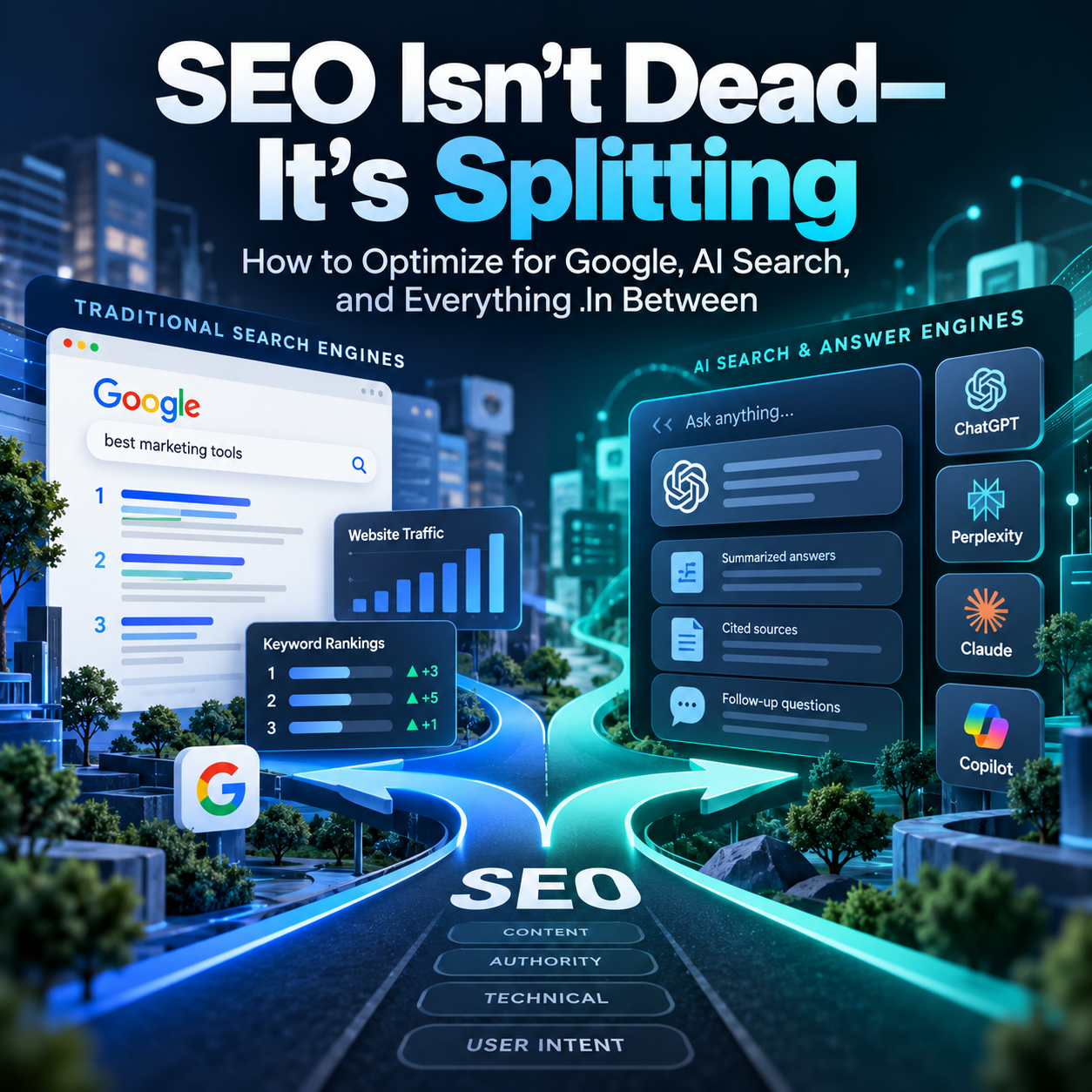
Traditional SEO already created significant competition for visibility.
AI search raises the stakes.
Search engines and AI assistants can now synthesize information from multiple websites and provide users with direct answers.
That means businesses cannot rely solely on producing another version of information that already exists.
If twenty articles say essentially the same thing, an AI system doesn’t necessarily need all twenty.
The content most likely to remain valuable is content containing information that cannot easily be recreated through summarization.
Think about the difference.
Generic content says:
Businesses should post consistently on social media to increase engagement.
Human-centric content says:
After managing social campaigns for local businesses, we’ve found that posting more frequently rarely fixes weak engagement. The bigger issue is usually that the content isn’t giving people a reason to respond.
The first statement is technically correct.
The second has perspective.
Generic content explains.
Human-centric content contributes.
That distinction will become increasingly important as businesses compete for visibility not only in traditional Google results but also in AI-powered search environments.
For years, SEO writing sometimes encouraged businesses to suppress personality.
Marketers worried about exact keyword placement.
Headings were engineered around search queries.
Paragraphs were written for algorithms.
Articles frequently became interchangeable.
Today, brand voice can become an advantage.
Search engines are increasingly capable of understanding meaning, context, entities, relationships, and expertise beyond exact-match keywords.
Meanwhile, audiences are becoming better at identifying generic AI-generated language.
That combination creates an opportunity.
Businesses can write naturally while still practicing strong SEO.
Instead of asking:
“How many times should we use this keyword?”
Ask:
“What can we say about this subject that actually deserves to rank?”
That might include explaining something your competitors avoid discussing.
It could mean sharing an unpopular opinion.
It could involve publishing actual pricing information.
Maybe it’s explaining why a commonly recommended strategy doesn’t work for certain businesses.
Perhaps it’s sharing what your team learned after executing fifty campaigns.
Those details create differentiation.
Marketing ultimately requires trust.
Before someone hires a marketing agency, attorney, contractor, consultant, financial advisor, software provider, or local service business, they are evaluating more than capabilities.
They’re asking questions such as:
Do these people understand my problem?
Do they know what they’re talking about?
Are they credible?
Do I like how they communicate?
Do I trust them?
Would I actually want to work with them?
Generic AI content struggles to answer those questions because it often removes the very characteristics people use to evaluate trust.
Personality.
Experience.
Vulnerability.
Specificity.
Judgment.
Opinion.
Human-centric content puts those signals back into marketing.
A local St. Louis business owner explaining what they learned from a failed product launch may be more persuasive than twenty perfectly optimized articles about product launch strategy.
A contractor showing the real challenges encountered during a renovation creates more credibility than another generic article titled “10 Home Remodeling Tips.”
A marketing agency discussing why a strategy didn’t work for a client — and what they changed — demonstrates actual experience.
People trust evidence of thinking.
Human-centric content may be particularly valuable for local businesses.
Why?
Because local knowledge is inherently difficult to commoditize.
A generic AI model can explain search engine optimization.
But someone working with businesses throughout St. Louis, St. Charles, Chesterfield, Clayton, O’Fallon, or the surrounding region may understand nuances that generic content doesn’t capture.
A local marketing agency might understand:
Which industries are highly competitive throughout the St. Louis area
What local customers care about
How regional businesses approach marketing budgets
Which networking communities matter
How suburban markets differ
Which seasonal patterns influence demand
What local competitors are doing
How customers describe certain services
That knowledge produces better content.
Instead of writing:
You could write:
Instead of:
Try:
Instead of:
Try:
One sounds generated.
The other sounds experienced.
This distinction is important.
Rejecting artificial intelligence entirely would be a mistake.
AI is one of the most powerful marketing productivity tools businesses have ever received.
The better strategy is:
AI-assisted. Human-directed.
Use AI to increase leverage.
Don’t use AI to remove the human.
Artificial intelligence can help with:
Research
Brainstorming
Topic clustering
Content outlines
Keyword analysis
Competitive research
Transcription
Repurposing
Editing
Summarization
Content organization
Data analysis
Drafting
Ideation
But humans should still provide:
Strategy
Judgment
Voice
Experience
Fact-checking
Opinions
Ethics
Context
Creativity
Customer understanding
Final editorial control
Think of artificial intelligence as a powerful junior strategist who can work incredibly fast.
You wouldn’t automatically publish everything a junior employee produced without reviewing it.
Treat AI-generated content the same way.
One of the strongest approaches for modern content marketing is what we might call the Human → AI → Human model.
The process begins with a human.
Before opening an AI platform, identify what you actually want to say.
Ask:
What have we learned?
What do our customers repeatedly ask?
What do competitors misunderstand?
What do we disagree with?
What happened recently that taught us something?
What result did we achieve?
What mistake did we make?
What advice would we give someone sitting across the table from us?
Those answers are the raw material.
Now bring AI into the workflow.
Ask it to help structure the argument.
Generate headline options.
Identify missing questions.
Organize sections.
Suggest supporting topics.
Analyze keyword opportunities.
Create versions for different platforms.
Turn the article into video scripts.
Turn the video into social captions.
AI becomes an accelerator.
This is the step many companies skip.
Review the content.
Delete generic language.
Add stories.
Insert examples.
Challenge weak assumptions.
Verify factual claims.
Change sentences until they sound like your company.
Add opinions.
Add personality.
Add context only your team could provide.
Then publish.
The goal shouldn’t be to hide that AI helped.
The goal should be to ensure the finished content couldn’t have existed without human expertise.
AI has made content volume an increasingly dangerous vanity metric.
“We published 50 articles this month.”
Great.
Did anyone read them?
Did anyone remember them?
Did they rank?
Did they generate qualified traffic?
Did customers reference them?
Did they earn links?
Did sales use them?
Did anyone subscribe after reading them?
Did they influence a buying decision?
The ability to create more content doesn’t automatically mean a company should create more content.
Ten exceptional articles containing actual expertise may create more business value than 200 generic AI-generated posts.
Marketing teams need to shift from measuring content production to measuring content impact.
Useful metrics might include:
Organic search visibility
Qualified organic traffic
Engagement time
Lead conversions
Email subscriptions
Brand searches
Backlinks
Social shares
Comments
Assisted conversions
Sales conversations influenced by content
Content should perform a job.
Publishing isn’t the job.
Another advantage human-centric companies have is access to something competitors can’t copy:
Their people.
Your employees collectively possess enormous amounts of experience.
Salespeople know the questions prospects ask.
Customer service teams know the frustrations customers experience.
Executives understand strategic decisions.
Technicians understand problems customers never see.
Project managers understand why projects succeed or fail.
Marketers understand campaign performance.
Instead of asking AI to invent content ideas, interview your people.
Ask your salesperson:
“What question did three prospects ask you this week?”
Ask customer service:
“What problem keeps frustrating customers?”
Ask your project manager:
“What mistake costs clients the most money?”
Ask your founder:
“What industry advice do you completely disagree with?”
Then use AI to help transform those conversations into articles, videos, emails, social posts, FAQs, and sales enablement materials.
That is human-centric AI marketing.
The intelligence begins inside the organization.
AI simply helps distribute it.
Brands have spent years polishing themselves until they sound almost identical.
Professional.
Safe.
Corporate.
Predictable.
Artificial intelligence can unintentionally accelerate that sameness because AI models often produce polished, middle-of-the-road language unless directed otherwise.
But audiences don’t necessarily connect with perfection.
They connect with authenticity.
A founder telling a slightly uncomfortable truth can outperform a beautifully written corporate statement.
A behind-the-scenes video shot on a phone can outperform a polished advertisement.
A strong opinion can generate more engagement than safe advice.
A customer story can outperform a generic case study.
A mistake can sometimes be more educational than a success.
Human-centric marketing gives companies permission to sound human again.
Businesses throughout St. Louis don’t need gigantic content teams to compete.
They need differentiated expertise.
Start by identifying what your company knows that competitors don’t communicate.
Then build content around those insights.
Interview your employees.
Document customer questions.
Create videos where leadership explains industry trends.
Publish local case studies.
Show actual work.
Share lessons learned.
Talk about mistakes.
Explain your process.
Challenge myths.
Create original photos and videos rather than relying exclusively on stock assets.
Put real employees on camera.
Talk about what’s happening inside your industry locally.
And yes — use artificial intelligence to make the process faster.
Just don’t allow AI to become the personality of the company.
The marketing conversation is often framed incorrectly.
Human versus artificial intelligence.
Which one wins?
That’s probably the wrong question.
The companies most likely to win will combine both.
AI provides speed.
Humans provide meaning.
AI provides scale.
Humans provide judgment.
AI provides patterns.
Humans provide lived experience.
AI provides efficiency.
Humans provide empathy.
AI can help create content.
Humans give people a reason to care about it.
The real competitive advantage isn’t simply adopting artificial intelligence.
Eventually, almost everyone will have access to similar tools.
The advantage comes from what you do with them.
The internet doesn’t need another million generic articles.
Your customers don’t need another perfectly formatted LinkedIn post that sounds exactly like every other LinkedIn post.
They don’t need brands producing content simply because an AI platform made it inexpensive.
They need useful information.
They need expertise.
They need stories.
They need honesty.
They need perspective.
They need brands willing to say something.
Artificial intelligence should help companies amplify those qualities — not erase them.
That’s why the rise of AI slop may ultimately create one of the biggest opportunities marketers have seen in years.
As generic content becomes cheaper and more abundant, genuine expertise becomes more noticeable.
As automation increases, personality becomes more valuable.
As everyone gains access to the same technology, human differentiation matters more.
The future isn’t about proving your content wasn’t created with AI.
It’s about creating content that clearly required a human to make it worth reading.
For St. Louis businesses competing for attention online, that may become one of the most important marketing advantages of all.
At Razor Sharp Digital, we believe technology should enhance marketing — not remove the people behind it.
Artificial intelligence can accelerate strategy, content, SEO, social media, and digital marketing execution, but genuine growth still requires experience, creativity, critical thinking, and an understanding of the people you’re trying to reach.
If your business is looking for a more human-centric approach to digital marketing in St. Louis, it’s time to rethink how AI fits into your strategy.
Contact Razor Sharp Digital today and let’s build marketing that people actually want to pay attention to.
Learn about strategic human marketing and how it can benefit your business.
Download for FREE TODAY!
Get all the latest content, news, and digital marketing insights to help you humanize your brand.
Join thousands getting our insider updates learning how to grow their business using AI + human centricity.
(P.S. We will NEVER sell your personal data to anyone like the other guys do)
Your company needs humanization and personalization in order for it to thrive and grow. Our systematic, strategic, and seasoned approach will help you thrive and grow. Let’s discuss ways we can help your business become more human-centric so you can dominate.
The main entrance to our primary domain.
The 10 commandments that we live by, practice by, and service our customers. The Holy Grail of our entire philosophy if you’d like to call it that.
The digital and social media vault where we share our insights, experiences, and advice on how to humanize your brand so you can thrive and grow.
A full breakdown of all of our service offerings in the digital and social media spectrum.
How it all started, our story, and who is behind this human marketing agency.
Are you a natural-born superstar? Looking to make a global impact? We are always seeking aspiring rockstars to join our team.
The best way to get in touch with us about your digital and social media needs.